Monthly Archives: September 2016

Hot Air: Old Folks

To be honest, I hadn’t thought about Dr. Ruth Westheimer in many years until I saw her name up on the Buskirk-Chumley Theater marquee this week. For that matter, neither I nor the people I told about seeing her name in lights were even aware she was still alive. That sent me flying to the University of Google where I learned she is a spritely 88 years old.

mtiwnja4njm0mdi0nti3mzcy

Dr. Ruth

A Herald Times story this morning about her appearance in Bloomington reports she doesn’t like seeing couples walking hand in hand on campus while each stares at and thumbs a smartphone.

Acc’d’g to reporter Abby Tonsing, Westheimer called the constant concentration on smartphone screens an addiction. “Look how they walk across campus,” Tonsing quotes her. “They don’t see anybody.”

Loyal Pencillistas know I’m a proud Luddite when it comes to texting, even though I finally relented this summer and got a smartphone. I have a data plan with a monthly limit and have yet to use even as much as a tenth of the data I’m allowed in a single month. That’s because I don’t text and I refuse to take other people’s texts.

I’m fairly certain that if I did start getting into the texting thing, I’d become as addicted as anyone else and I truly do not want to do that. I much prefer seeing the sky, the birds, fellow pedestrians, the driver next to me, the leaves on the trees, and the direction in which the clouds are scuttling across the sky. I’m afraid if I get sucked into the text universe, I’ll lose all those things. Let me explain: years ago, I swore to all the gods in all the heavens I wouldn’t read newspapers or magazines online nor would I lower myself into the Facebook swamp. Now, in the year of their lord 2016, I only read newspapers and magazines online — I haven’t bought either in hard copy form in years — and I FB every day.

The LED screen is indeed addictive. I don’t need another monkey, in the form of texting, on my back. I watch kids and adults gawking at their smartphone screens to the exclusion, as Dr. Ruth implies, of everything else in the universe. I have to assume these folks have no idea how far west the sun is setting these days, how subtly the leaves on the trees have begun to turn a dull green, and whether or not they are canopied by cirrus or cumulus clouds at the moment.

It’s always been terribly important to me to know all these things. I watch for signs of them them every year; they serve as landmarks for the passage of time. When I was a little kid, my friends and I every September would watch traffic with the diligence of FBI agents on the lookout for spies, searching for the new car models to appear. Whichever one of us managed to espy the new year’s Plymouth Fury, for instance, or the latest Chevrolet Biscayne would be hailed as a sharp-eyed master indeed.

Now, of course, I’m drawn to more natural appearances of things. The sun, the moon, leaves, summer birds, and so on. It’s still the same thing. Sometime next week, the sun will set almost precisely due west, right down the center of the roadway as we drive in that direction around a quarter to eight in the evening. I’ll hope to be driving that day and time just so I can say I’ve seen it. Don’t ask me to justify the attempt any more than I have already; I just want to do it.

Most of the rest of humanity will simply thumb in a google query to find out when sunset will be that day — that is, if they should have any wild desire to know it.

Me? I want to experience it.

Heads Up For Big Talk

If you’ve got a few spare minutes, pelase remember to listen in late this afternoon at about 5:45 as Bloomington Print Collective co-founder Danielle Urschel joins me as my guest on Big Talk.

Big Talk Logo Usable Screen Shot

Big Talk is a regular Thursday feature on the WFHB Daily Local News. You can click on the Big Talk tab up above to hear podcasts of previous editions as well as largely uncut Big Tracks of the original taping sessions.

Next week’s guest: Kristin Leaman-Morris Indiana University archivist for the state bicentennial celebration.

We Need It

This one’s always appropriate no matter if the year is 1965 or 2016. Written by the brilliant Bacharach/David team, the man behind the melody, Burt Bacharach, really didn’t like the song. B&D first offered it to Dionne Warwick who herself didn’t think much of it and so turned it down. Jackie DeShannon grabbed it and turned it into a big hit in ’65. Three years later, Warwick recorded it and then recorded it again nearly 30 years after that, in 1996. Only Warwick’s second recording charted, briefly, yet she seems more ID’d with the song than DeShannon who’s hardly remembered today.

Anyway, subsequent covers have been recorded by the likes of Judy Garland, Aimee Mann, Barry Manilow, Coldplay, and even the rickroller himself, Rick Astley.


Hot Air: Boys Will Be Boys

With a bizarre, masked home invader scaring the bejesus out of half the citizenry, rape has become perhaps the top topic of discussion in workplaces, at dinner tables, in bars and coffeehouses, and pretty much everywhere else females gather here in Bloomington.

Now, if we were to eavesdrop on any type of male-only pow-wow we likely wouldn’t hear the first reference to the punk who’s sneaking into homes of late and trying to rape lone women therein. And isn’t that an awfully big part of the problem? Why wouldn’t men be just as outraged as Bloomington’s women are?

The answer: Men don’t have vaginas. They have no skin in the game. So they couldn’t care less. In fact, too many of them — far, far, far too many of them — think the women who’ve been victimized by this weasel probably deserved their fate. Hell, they shoulda locked their doors or had a gun in the nightstand or shouldn’t’a dressed so alluringly — even though, I might remind you, the women were home alone, not expecting a masked psychosexual felon to barge in.

Most men simply don’t get rape. Tons of males think women secretly want to be raped, would love to be raped, and would swoon for the strongman who has the gumption and the guts to take what he wants from them by force.

Most men are idiots.

And now rape, for the umpteen-zillionth time, has become national news. A female student at the University of North Carolina at Chapel Hill has claimed UNC football player Allen Artis raped her in February. The incident, student Delaney Robinson says, took place in an apartment on campus early Valentine’s Day morning. Robinson says she was drinking but insists, rightly, that does not give anyone license to commit a violent or forceful crime upon her person.

screen-shot-2016-09-13-at-10-41-24-pm

The Best Defense Is A Good Offense

Nevertheless, Robinson says, when she reported the rape at a local hospital, officials in charge of protecting the university from rape accusers, AKA the school’s Department of Public Safety, peppered her with questions about her sexual history, her sexual proclivities, and whether or not she had led Artis to believe he’d strike gold that early morning. “I was treated like a suspect,” she says.

Odd — isn’t it? — that school Public Safety officials would grill her rather than console her and assure her justice would be done. That’s what they’d have done had she accused Artis of swiping her smartphone. Now, that’s a crime that can’t be tolerated.

Then again, the way they treated her wasn’t odd at all.

It gets worse. Robinson says she and her attorney have viewed videotapes of the question-and-answer session DPS had with Artis after the incident was reported.

She told reporters yesterday:

Rather than accusing him of anything, the investigators spoke with him in a tone of camaraderie. They provided reassurances to him when he became upset. They even laughed with him when he told them how many girls’ phone numbers he had managed to get on the same night he had raped me. They told him, “Don’t sweat it. Just keep on living your life and keep on playing football.”

Artis, a junior, plays defense for the Tarheels. On the Tarheel Times‘ football team depth chart, he’s listed as the third strong side linebacker. Depth at linebacker is of vital importance for any football team’s defense. It’s certainly more important than the fragile feelings of some drunken little slut. How much do you want to bet that’s how Delaney Robinson is being described in the Tarheels’ locker room these days?

Anyone who isn’t outraged by the investigators chuckling and chortling with Allen Artis as he bragged about how many bitches’ phone numbers he collected that night simply doesn’t get rape. Maybe because they don’t get raped.

Rape, to them, is somebody else’s problem. The real problem, I’m sure too many UNC officials must feel, is finding a way to beat the James Madison University Dukes at Chapel Hill Saturday afternoon.

Life’s problems sure are simpler when you don’t have to worry about getting raped.

Hot Air: Talk The Talk

Big Talk Logo Usable Screen Shot

I’ve said it before and I’ll say it again: What a lucky guy I am! I get to sit down on a weekly basis and speak at length with energetic, imaginative, creative, successful in the most profound sense of the word, Bloomington people.

My Big Talk features Thursdays on WFHB’s Daily Local News and the Big Tracks extended interviews on this communications colossus allow me to rub shoulders with folks I can only wish I could emulate.

Yesterday, I interviewed Danielle Urschel, co-founder of the Bloomington Print Collective. The BPC has gathered some of this town’s finest printers — and there are many ways printers can print, something you’ll find out about Thursday — so they might pitch in, share their talents, expertise and equipment, all geared toward fostering their art and commerce.

screen-shot-2016-09-13-at-8-57-42-am

Danielle Urschel

I’m always deeply impressed by how articulate and entertaining these folks are — and Danielle fits right in with the rest of my Big Talk peeps.

Tune in to WFHB, 91.3FM (as well as 98.1, 100.7, & 106.3 in surrounding areas), Thursday at 5:30pm to hear this latest Big Talk episode. A couple of days later, I’ll post a podcast of the feature and the Big Track here on The Pencil.

Keep in mind upcoming guests include David Brennaman, director of Indiana University’s Eskanazi Art Museum, and Kristin-Leaman Morris, archivist for the Indiana Bicentennial. Like I said, I’m lucky.

Before I dash off to sell books, lemme express undying gratitude to WFHB News Director Joe Crawford, Ass’t News Director Sarah Vaughan, acting GM Jar Turner, and engineer Jeff Morris for welcoming me and my show and making my delightful task so much easier than it might have been.

We’ll talk soon.

Hot Air: Beatification

Now Then

Let’s start off with some quotes about thinking, writing, and being.

You should work to reduce your biases, but to say you have none is a sign that you have many.

— Nate Silver

Truth to tell, it is a lot better to have written a book than to actually be writing one.

— Joseph Epstein

There lurks, perhaps, in every human heart a desire of distinction, which inclines every man to hope, and then to believe, that nature has given to himself something peculiar to himself.”

— Samuel Johnson

screen-shot-2016-09-12-at-1-14-11-pm

Silver, Epstein & Johnson, Attorneys At Life

Holy Molars

You want a saint? I’ll give you a saint.

His name is Greg Nycz. NPR’s Morning Edition today had a piece on the chain of dental clinics he started in rural Wisconsin. The report mentioned one 2014 study that showed a quarter of Americans don’t get dental care because they can’t afford it. Even if someone’s on federal medical assistance, they won’t get access to dental care because the vast majority of dentists don’t accept Medicaid. To top it all off, dentists are rarer than, well…, hen’s teeth in rural America.

screen-shot-2016-09-12-at-11-26-54-am

So this fellow Nycz, who was executive director of a chain of medical clinics for the poor in Wiscoinsin, got the brainchild to start a similar chain for dental care after hearing of the agony many poor people went through when their teeth were rotting out of their heads. He tells of one woman with whom he spoke over the telephone whose kid was screaming and sobbing from pain in the background. The mom couldn’t afford a dentist. When telling the story, Nycz chokes up.

He started the first dental clinic for the poor in Wisconsin in 2003. There are now 10 such centers; they can serve 60,000 patients a year.

Do yourself a favor and listen to the report — or at least read the Morning Edition website’s recap of it. It’ll do your heart good.

Struttin’

It’s fun to trace the evolution of a hit. Here’s one of the great one-hit wonders of all time, “Soulful Strut,” by Young-Holt Unlimited. A couple of former members of Ramsey Lewis’s jazz trio, Eldee Young and Red Holt, formed YHU along with a number of third parties to complete the new trio. “Soulful Strut” charted during Christmas season, 1968.

The song originally had been recorded in 1966 by Barbara Acklin under the title “Am I the Same Girl.” That record’s producer, for reasons unknown, removed her vocal track and replaced it with a piano track, resulting in the single credited to Young-Holt Unlimited under the different title two years later.

The song had been written by Eugene Record (yep, that was his name), who was the lead singer of the Chi-Lites. He and Barbara Acklin had co-written one of the Chi-Lites’ biggest hits, “Have You Seen Her?” Now listen to the tune as covered in 1992 by Swing Out Sister, with lead vocal by Corrine Drewery:

Hot Air: The Gift

If I were the kind of guy who believes in miracles, I would say meeting a certain elderly fellow yesterday morning was a miracle.

I was about as uncomfortable as I could be. I’d been wracked by worry the previous few days, fretting over my six-month CAT scan and the results thereof so much I could hardly sleep Tuesday and Wednesday nights. The worry and the lack of sleep had turned me into an even ornerier bear than I normally am. If it was uncomfortable for people to be around me, imagine what it was like actually being me. Suffice it to say among my least favorite people on Earth was…, well, me. (I wasn’t my absolutely least fave human; there still exist, after all, tyrants, racists, rapists, child molesters, and D. Trump.)

No matter that it was a gorgeous, sun-dappled September morning. I couldn’t see the beauty of it. I could only see the possibility that My Olive Pit™ and its little friends that had resided in my neck up to half a year ago might — only might, mind you — have started to grow again.

my-olive-pit-logo-copy

Fear easily becomes hate. The sleepless previous few days had provided fertile soil in my heart for the invasive, destructive weeds of odium. I’ve no doubt others could smell the loathing within me. I hated the world.

I walked into the Book Corner and didn’t greet customers and my co-workers with my usual bonhomie. I grunted. My brow was deeply furrowed. I was dismissive.

A customer was asking Margaret, the owner, about music books. Having seen me enter, she immediately told him, “Mike’ll help you. Mike, show this man our music section.”

I hated her with a deep, abiding passion at that moment. I thought, “Can’t you see I’m miserable? I just walked in, for chrissakes. I haven’t even taken off my sunglasses yet. I’m still carrying my lunch and my coffee mug! And now you want me to help some idiot?”

I grunted again.

I passed the customer who looked toward me expectantly. I ignored him. Out the corner of  my eye, I could see the look of puzzlement on his face.

The hatred within me grew exponentially. I hated him, sure, but I hated myself even more for hating him. I hated him doubly for his innocence, causing me to hate myself all the more. Hate cubed.

I dashed downstairs to the toilet where I could sob a bit and try to get hold of the raging hatred within. “Get it together, you jerk,” I muttered to myself. “You have no right to visit all this upon the world. Straighten up!”

I climbed back to the sales floor determined to fake it. I slapped the phony friendly face on. Margaret glanced at me, a questioning look on her face. I was afraid if I tried to explain what had been going on within me I might break down and cry. The customer who’d been interested in music was sitting in a folding chair, thumbing through some music biography. He, too, glanced at me. I was fully expecting him to throw eye darts at me. Hell, he’d have been more than justified.

But the man looked at me with what I could only interpret as love.

Patty, my colleague, asked me what was wrong. I said I’d be seeing my oncologist the next day.

The customer closed the book he was looking at, rose from his chair, and inched toward me.

“I heard what you said about the oncologist,” he said in an African accent. He was thin and well-dressed, with distinctive wrinkles on the bridge of his nose. His eyes were warm but rheumy. His hands and fingers were long and tapered; he used them for punctuation.

“I myself was given the same gift,” he went on.

Gift? Cancer is a gift? I might have concluded this bird was specifically a loon but somehow, some way, that ridiculously inappropriate descriptor drew me in. I knew — I just knew — I should listen to him .

He shared his story* with me.

His name is Emmanuel. He was born in what is now Zimbabwe but, when he was a child, was known as Rhodesia. He grew up in an apartheid world, the dark-skinned majority ruled by paternal and despotic white sons and grandsons of immigrants from England and Scotland. Emmanuel attended the Catholic-run Chishawasha Mission Primary School, inspiring him to enter the priesthood.

He served as the chaplain of Rhodesia’s main state prison for a time. There, he came into contact with Zimbabwe African National Union leader (and future Zimbabwe prime minister) Robert Mugabe. The two had already known each other. Emmanuel first met Mugabe at Kutama College in the Zvimba region, southwest of Harare. Emmanuel was a student and Mugabe a teacher there at the time.

Mugabe and his allies had been sent to the state prison for their independence efforts and spoke often about their cause. What they said made sense to Emmanuel so he pitched in and helped them when, after their release from prison and subsequent sentence to house arrest, they attempted to flee Rhodesia. Emmanuel hid them in his rectory and then drove a getaway car that took them into Mozambique. From there, Mugabe led rebels in the Rhodesian Bush War that eventually toppled the colonial government.

Emmanuel considered himself a writer in the early part of his adult life. He wrote Machadura, called “one of the most prominent Shona novels of the 20th Century,” by Harare journalist Tendai Hildegarde Manzvanzvike. (The Shona are a Bantu subgroup of some 11 million farmers and herders in southern Africa.) His real passion, though, was music. One Catholic magazine has described him as the composer of the first Shona church hymns in the 1950s. He travelled around the country listening to children singing folk hymns and spirituals. “I wrote them down,” he said, elegantly pantomiming the act of putting pencil to paper. “No one had ever done that before.”

His diligent recording of the songs brought him worldwide attention. Indiana University came calling, offering him a position at what’s now known as the Jacobs School of Music. “They invited me because they wanted my collection of songs,” he said, laughing.

One day some 13 years ago, Emmanuel woke up in the middle of the night bleeding profusely. “I cleaned the blood up,” he said, “passed out, and then drove myself to the hospital.”

Doctors discovered a massive tumor in his abdomen that had ruptured. “It was the size of two babies,” Emmanuel said. Pantomiming again, he explained, “They cut it out of me.”

He’s been cancer-free ever since.

As I listened, I watched his rheumy eyes. They were magnetic. I couldn’t understand why anyone would describe such a horror as a gift. But he did. I might have asked him what he meant, but I didn’t. I suppose it was enough for me to know he simply saw the malady as something that added to the sum total of his life.

All I could do was offer both my hands to Emmanuel. He said he was in town for the usual round of tests to make sure the cancer hasn’t returned. I stared deep into his eyes. I stopped hating myself for being such an ass.

Perhaps that’s why he sees his two-baby-sized tumor as a gift.

Fr. Emmanuel Ribeiro is one of the heroes of Zimbabwe. Journalist Manzvanzvike has called him “the embodiment of Zimbabwe’s spiritual, social, cultural and political journey.” She observed, “Beyond the oceans, he has been Zimbabwe’s unofficial ambassador….” Manzvanzvike once asked him who he was. He replied, “This will produce a five-volume book, but the simplest answer is that I don’t know.”

I know. He was the guy who had an almost supernatural capacity to save me from myself on a very bad day.

[ * Part of Emmanuel’s story comes from Emmanuel himself. The rest comes from articles in the Zimbabwe Herald, allAfrica, Zim Catholic magazine, and The Sunday Mail.]

screen-shot-2016-09-09-at-10-23-49-pm

Ribeiro

BTW: The results of my six-months post-chemoradiation CAT scan and complete blood panel are in:

  1. All kidney, liver, and thyroid functions are good.
  2. No cancer markers found in the blood.
  3. No signs of any growth of previously malignant lymph nodes or development of new ones.

In other words, Yay! I remain in remission. Phew! Now I can get my first good night’s sleep in days.

That’s a gift, too.

Hot Air: Life Is Not Fair…

Really Not Fair

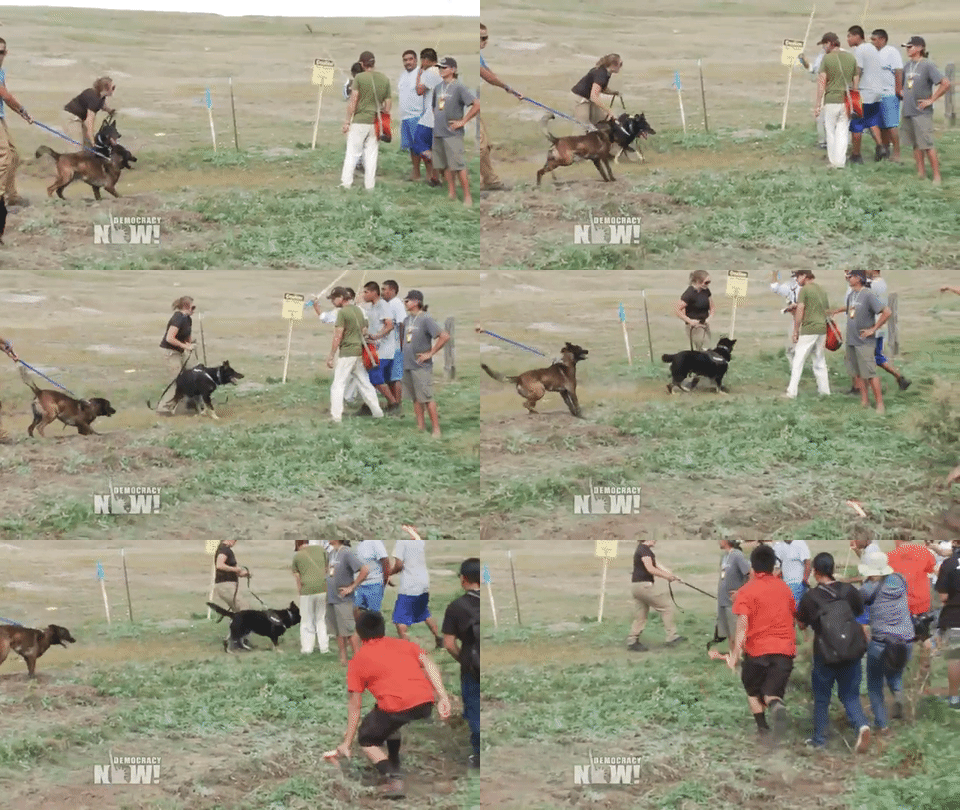
At first I found it nearly impossible to comprehend why various governmental agencies and private security firms have sicced guard dogs on those Standing Rock Sioux protesters at the site of the Dakota Access Pipeline not even ten months after other agencies allowed all those Bundy-ists to take over the Malheur National Wildlife Refuge and let them occupy it for nearly six weeks.

giphy

giphy

Who Let The Dogs Out?

To be fair, one of the Bundy blowhards was shot dead late in the Oregon standoff, an incident that inspired within me neither sympathy nor grief. Of course, LaVoy Finicum had to attempt to run down an FBI agent at a roadblock and then reach for a semi-automatic pistol in his jacket pocket before anybody opened fire on him. I suppose those acts might be deemed a tad more dangerous than a ragtag band of Sioux waving placards and shouting slogans, even by FBI agents.

Hell, the original Bundy boneheads and their sympathizers aimed high-powered rifles and automatic weapons at law enforcement officials the first time they threw a tantrum, in southeastern Nevada back in 2014. It’s no wonder someone got an itchy trigger finger toward the end of the Malheur episode.

screen-shot-2016-09-07-at-9-58-09-pm

Bundy Supporter LaVoy Finicum Packs Heat At Malheur

[Photo: Rick Bowmer/AP]

Sioux adults and children are being gnawed bloody by the guard dogs even though, for pity’s sake, the protesters aren’t armed. Did I neglect to mention all the pepper spraying going on?

Shockingly, law officers allowed the Malheur occupiers to come and go as they pleased throughout much of the standoff. And, boy, when the fracas was finished, Refuge officials found that the occupiers had vandalized much of the property because…, well, just because.

The Sioux figure they’ve got the good word of the US Gov’t to back up their case. This holy land had long ago entered into a pact with these particular Sioux guaranteeing no one would ever mess with their natural resources at Standing Rock. Then again, all such pacts between the feds and various aboriginal American groups were packs of lies, so what did the Sioux expect anyway?

Still, there’s the fact that each of the protesting groups is claiming the freedom to commit civil disobedience in response to government overreach. So, why aren’t the two groups being treated equitably?

The only difference I can make out is the Standing Rock Sioux were short-sighted enough to be born into a racial lineage that had suffered a federally-sanctioned genocide. The Bundy gang and their ilk had the good fortune to be born into the racial lineage that did the genociding.

It’s enough to make me want to sit down during the national anthem.

Hot Air: Haste

A few quick items before I have to dash off and sell books.

Populist Lingo

So, this newly-elected president of the Philippines, a character named Rodrigo Duterte, has called Barack Obama the “son of a whore.”

Duterte is a notorious serial philanderer and has spewed any number of stunning statements: he has cursed Pope Francis for visiting the Philippines and causing a traffic jam; he gay-slurred the US ambassador to the Philippines; he has pledged on numerous occasions to kill various petty criminals; he has admitted okaying thousands of extrajudicial killings in the Philippines’ drug trade war; he has advocated the assassinations of journalists whom he’s deemed corrupt; he even once pooh-poohed his own daughter’s claim that she was raped, calling her a “drama queen.” During the spring presidential election, he catcalled and whistled at a female reporter.

All this from the leader of a nation of more than 100 million people.

Is it my imagination or did world leaders at one time in the not-too-distant past tend to avoid calling each other names like sons of whores?

Duterte, like our very own D. Trump, is a populist who has gained enormous popularity as a man who says what’s on his “mind,” is a tough-talker, and who speaks “truth.”

One commentator yesterday said Duterte is a lousy example of a Filipino. Hmm, I wonder. His trust and popularity rating reached a jaw-dropping 91 percent in the country the week after he assumed office in June.

And, of course, Duterte has apologized for the Obama remark. Well, to be precise, he accepted no responsibility for being an uncivilized brute. His apology wasn’t for being a dick; it was for everybody wrongly concluding that he’s a dick. Duterte went on to express regret that his words came out as a personal attack. See, it wasn’t him, it was the words. Maybe they’re sons of whores, too.

Boom!

Just a little reminder: The United States of America has never officially renounced the first-use of nuclear weapons. People who pretend to be sane about such things like to posit that a nuclear power merely possesses these existentially terrifying devices as a deterrent against another bad guy using them. The truth is our holy land places its approximately 7300 nukes at the forefront of all its military posturing and diplomatic initiatives. No nation on Earth ever forgets that if anyone pushes the US far enough, it’ll drop a big one or two on them.

Obama has pledged to move the planet toward a nuclear-bomb-free future but he’s finding that a near-impossibility. He can promise all he wants but the iron triangle comprised of the Pentagon, the defense industry, and the Congress is immovable as the Rock of Gibraltar. Then there are those pesky Russians and Chinese, each of whom has issued a no-first-use pledge but neither of whom is particularly trustworthy. I should add, each is about as untrustworthy as we are.

Obama was thinking of making the no-first-use pledge this week at a summit of Southeast Asian nations where he’s the first sitting US president to step foot into Laos. His advisers got hold of him and persuaded him not to get so warm and fuzzy.

One of the things we lose sight of when we talk about America’s nukes is how our national economy, as well as those of all the fifty states, are tied up in the manufacture of them.

No Talk

Big Talk Logo Usable Screen Shot

Just a heads up: There’ll be no Big Talk this Thursday on WFHB‘s Daily Local News. The station is running its annual fundraiser, so on-air voices’ll be hitting you up for dough. Big Talk will return Thursday, September 15th. Talk to you then.

Aria Calda: Sta Venendo!

My mother died more than two and a half years ago. Her mother, Anna Lazzara, named her Susan, because she was born so close to the Feast of the Assumption of the Blessed Virgin Mary. The Italian word for assumed is assunta. Ma’s surname was Parello; grandma had a different last name because she was one of the rare women of her generation and station in life to divorce her husband. Grandma was a tough old bird and so, in her own way, was Ma. In fact, she made it her life’s work to keep her marriage together through, as I like to characterize it, thin and thin. Ma’d brag about how everybody told her she and my Daddy-o, Joe Glab, would never make it. He was 20, she 16. In fact, she and he had to run away to Indiana to get married because a 16 year old girl could do so in the Hoosier State as long as a relative over 21 signed for her. Somehow, she’d convinced Uncle Louie and his Polish-American wife, Aunt Vera, to accompany her and Dad over the state line. Maybe they did so because my father was a first-generation Polish-American as well.

Anyway, Ma loved to say, “I showed ’em” — especially after all but one of her siblings’ marriages ended in divorce.

Screen Shot 2016-09-04 at 10.07.29 PM

Ma & Dad, 1945

Ma made it to 92 which is a good long life. She’d accomplished everything she’d ever wanted. She’d owned a home. She paid all her bills. She saved enough to take care of her husband and herself through their retirement years. She had enough left over to bestow a nice little chunk of change on each of her surviving kids. She got all four kids through high school and even steered one through college. None of us spent too much time behind bars, for which I guarantee she thanked her god every night of her life. She did lose one of her kids, the eldest, Frances, to cancer (although Franny herself reached the age of 68, which is within shouting distance of a good long life.)

Ma even learned to drive when she was in her 70’s. And, to her eternal credit, she gave up driving as soon as her mind and reflexes began to slow down.

Had she been able to deliver a valedictory, she’d have said, “It’s time. I’ve had enough. There’s nothing more for me to do.”

But she’d have misspoken. Her passion in life, passed down to me, was the Chicago Cubs.

One of my fondest memories of childhood — hell, my fondest, period — was coming home from school on a spring day and seeing her hunched over her big bread pan, kneading away at the dough for half a dozen loaves of bread, enough for the week. Ma was intense; she’d plunge one fist after another into that dough with the force of a Cassius Clay right hook. Her mouth would be pinched into a determined O.

“Hey, Ma…,” I’d begin, either to ask to go out or maybe, first, cadge a piece of last week’s remaining loaf, toasted and buttered the way I loved it.

“Just a minute,” she’d snap. “I’m busy. I’ve got seven minutes (of kneading) left.”

So, I’d sit at the kitchen table and wait. Her little Sears Silvertone transistor radio would be on, tuned to WGN, the voices of Vince Lloyd and Lou Boudreau at Wrigley Field describing how badly the Cubs were losing that day.

The smell of fresh bread dough and the sounds of the Cubs game — and my mother’s love — became intertwined. Heaven, I imagined, would be nothing more than a seat in the upper deck of Wrigley Field on a sunny May day with the wind blowing out.

To this day, I still keep transistor radios around the house. They’re archaic, sure, but they were good enough for Ma and so they’re good enough for me.

Ma’s Cubs finally became good for a spell beginning in the late 1960s. By 1969, they were powerful enough to race through the National League, taking an eight and a half-game lead over the New York Mets who, in their entire history had never enjoyed a winning season and whom, everyone knew, weren’t nearly good enough to supplant the Cubs atop the standings.

Ma was beside herself with glee. She’d actually shout “Yay!” when Banks or Williams or Santo would hit a home run. She’d clap, even if she thought she were alone in the house, and comment, “Thata boy!” as whichever hero of the moment crossed home plate.

Screen Shot 2016-09-04 at 10.10.35 PM

Euphoria At Wrigley, August 19, 1969

Of course, the Cubs lost that year to the Miracle Mets. Ma turned glum as summer turned to fall. “They’ll never do it now,” she’d say after it’d become clear the Cubs were suffering a collapse of historic proportions. She meant not only would the Cubs not turn their fortunes around that year, but any year to follow. She’d repeat that curse every year thereafter. “If they couldn’t do it in ’69,” she’d pronounce, “they’ll never do it.”

santo-shea

The Black Cat, Shea Stadium, New York, September 9, 1969

Still, she wished and dreamed and hoped. And she listened to her Cubs on her transistor radio until the end of her life. A life spent without once seeing her beloved Cubs win a World Series — something one team must do (it’s right there in the rules!) every single year. Not the Cubs though. “They’ll never do it,” Ma’d intone, but she never turned that radio off.

Now, this year, today, the Cubs are the elite team of Major League Baseball. They lead their division, as of this Labor Day, the traditional demarcation point when the games become deadly serious, by a whopping 16 and a half games. No other team in the sport comes within six wins of their total of 88. They will win more than a hundred games this year for the first time since 1935. Nineteen-goddamned-thirty-five. FDR was president. Adolf Hitler had only been Germany’s chancellor for a little than a year and a half. Among the things not yet invented in 1935 were the jet engine, the ballpoint pen, aerosol spray cans, kidney dialysis, the electronic computer, velcro, the credit card, the birth control pill, the television remote, and the transistor radio itself, for chrissakes.

I have a sneaking suspicion Ma would have admitted they can do it this year.

I wish I could say to her, “It’s coming!” Ergo today’s headline: Sta Venendo!

Of course, that line is preambled by Aria Calda — this site’s unofficial motto. Hot air.

Hot Air

Problem Solved

One of the characteristics voters look for in a candidate is the ability to offer clear, defined solutions to problems.

D. Trump, for instance, is well-known for offering clear, defined solutions. Recently, he offered one solution that is so straightforward, so to-the-point, and so simple that it’s doubtful he’ll ever offer another so effective.

He said the following, in reference to the nearly unbearable problem of undocumented immigrants in this holy land, a problem that bedevils all of us, every day of the week, 24 hours a day, and that is so pernicious that many good Americans find life not worth living in this once-great nation anymore:

My first hour in office, these people are gone.

Clear. Defined. Simple. Straightforward. To-the-point. It is the apotheosis of the long list of D. Trump’s solutions. He’ll never be able to top this one.

In fact, it can be said it’s his Final Solution.

Junkies

So, a part of Tornado Alley was rocked by a magnitude 5.6 earthquake this morning. The seismic rattle was centered underneath a point not far from Pawnee, Oklahoma.

Temblors, tremors, and other geo-jigglings once were fairly rare in that neighborhood, even though Oklahoma sits atop a spiderweb of fault lines. The lines are so minor, though, that slips and strikes of any appreciable size historically have been scarce there. The US Geological Survey report on the state’s earthquake history mentions eight judderings in all of the 20th Century.

In the 21st Century, though, this holy land’s fossil fuel industry has ramped up its fracking operations, with lots of them situated in the Sooner State. No doubt plenty of folks will be hollering about the greed of the oil companies digging these wells, which most scientific observers say probably weaken the sub-surface infrastructure surrounding them.

Far be it from me to defend greedy, corporately sociopathic outfits but I feel compelled to remind one and all that it is we — us, the sainted people, the salt of the Earth — who are, in the immortal words of petro-beneficiary George W. Bush, “addicted to oil.”

Screen Shot 2016-09-03 at 12.12.40 PM

Gimme

We want it. Lots of it. Cheap, too. So much so we’ll happily go to war to insure unfettered access to the crude stuff sitting in reserves within the sovereign borders of other nations. And when we occasionally feel a tad skittish about killing countless civilian non-combatants, we simply finance proxy wars. Why, it’s the American way — let some other poor sucker do the dirty work.

Sure, oil co. CEOs and their bean counters are maniacally eager to blast maws into the crust of the planet and then shoot destructive floods of water into them in order to force out the recalcitrant shale oil hiding therein. Our collective reaction? Huzzah! We get more gas for our hot rods and the good money we pay for it stays right here at home.

Everybody wins.

Except when there’s an earthquake.

Turtling

Some wise guy told me he nearly confused my high school graduation picture with a photo of “the lead singer of the Turtles.” I could have taken it as an insult; instead, I graciously accepted it as a ringing compliment. Here’s a pic of the Turtles:

Screen Shot 2016-09-03 at 11.29.23 AM

The Turtles

That’s one lead singer, Mark Volman, second from the left, and the other, Howard Kaylan, center. You can argue that Simon & Garfunkel were the greatest Jewish act in rock ‘n roll history and you’d probably be right. But the runners-up for that title would have to be the Turtles. And Volman is proof positive that a fat man can still be cool and hip.

Anyway, here are the Turtles:

Hot Air: Big Talk

Big Talk Logo Usable Screen Shot

Heading outward from the Earth in a sphere-shaped electromagnetic wave shell, racing along at some 186,000 miles per second, last night’s episode of Big Talk featuring Ryder magazine and film series founder Peter LoPilato, should reach the possibly inhabited Earth-like planet, Proxima b, by…, oh…, let’s say December 1st, 2020.

So, the Proximans will have to wait. You, though, can hear the interview right now through the magic of clacking on your keyboard so as to access links to the audio.

4000

Coming To A Planet Near You

Click here for WFHB’s Daily Local News Features site. Click here for this communications colossus’s Big Talk page and scroll down to the LoPilato entry.

And — hey — how’d you like to hear the entire nearly-hour-long interview with Pete? Yup, we’ve got it on the Big Talk page. While we were at it, we also put up the Long Track of last week’s Big Talk with Lucky Guy Bakery founder Joni McGary and Hopscotch Coffee co-owner Jane Kupersmith.

Happy listening!