Monthly Archives: November 2017

Hot Air: Poles Apart

Allow me, please, to simplify economics, especially now that we’re dealing with budget issues and possible tax reform on a national level.

There are two polarities — the Right and the Left. The Right, natch, is conservative and Republican, at least in this holy land. The Left is liberal (in the traditional 1950s & ’60s sense) and Democratic. And me, BTW.

Okay. The Left holds that everybody who’s born has a right to a fair piece of the pie. All humans in this mad, mad world deserve to eat, have a roof, get an education, and have access to health care. The wealth of the world is ours, in other words.

The Right says wealth must be controlled and allotted by a certain few, that the common clay is too rash and too undisciplined to be trusted with the planet’s treasure. Corporate execs and bankers are messianic figures who make certain the ledger book is neat and that the principles of vaunted economic theorists are honored.

The Left says need is paramount. The Right, process.

I fully expect to be upbraided for this thesis.

Cop Flop

I wish to remind the world there was once an American television show called Cop Rock. It was a mash-up of the gritty police procedural genre popularized by Steven Bochco (who was the show’s co-creator) and musical theater.

It was set in Los Angeles, in a variety of station houses, courtrooms, and street scenes. The cops’d make a bust, for instance, and then, suddenly, burst into a song and dance routine. TV Guide called it “the single most bizarre TV musical of all time” and ranked in No. 8 in its list of the worst TV shows ever, period.

Here’s a clip:

Thank heavens there’s still capital punishment in this holy land. The wonder is how Steven Bochco has managed to escape the executioner’s noose for these many years.


Hot Air: She Goes There

Life Or And Death

Yesterday I went all anti-god. Today, the other side gets its crack at it all. Constance Furey is a religious maven at Indiana University, a professor who has studied such wide-ranging topics as:

  • Christianity in Early Modern Europe
  • Friendship and community formation
  • Devotional poetry
  • Gender and Religious Subjectivity

Well, I’ll be damned (probably, for all the things I’ve done) but C. Furey sure as hell ain’t no prim old priest wagging her finger at us. Add to that the fact that I have no idea if she’s even a pious sort — hell, she could be a interested in religion simply for the academic exercise of it all. I mean, one doesn’t go around pestering others with Qs like Do you believe in god?, How much?, What do you pray about?, etc.

Anyway, she wrote of death and life in a piece that ran yesterday in a journal called The Immanent Frame. The online mag carries articles dealing with “religion, secularism and the public sphere.” Furey’s piece is part of a series of essays called “Is This All There Is” (sans the question mark, I’d assume, by design). Constance’s foray touches on the deaths of her parents and relates them to a lesson she learned while, a small girl, watching the TV sitcom character Latka Gravas from Taxi.

I wonder if Constance was aware that for many years after his death, the man who played Latka Gravas — Andy Kaufman — was rumored to be alive and his purported passing merely an elaborate prank. Constance speculates on “the bright line” that may or may not exist between life and death. For a good five to ten years, Kaufman blurred that line so thoroughly it virtually disappeared.

I suppose now we can safely conclude that Kaufman is dead — but, again, what if the gag has come this far? What if he’s working in anonymity in some cafe, busing tables, just living, shorn of the onus of fame, the demands of celebrity, and the responsibility of constantly striking while the iron’s hot? Kaufman was known for slipping away and becoming just another face on the crowd even as his sitcom and his own star were ascendent. Can he have pulled off the trick for lo these 33 years?

If so, that’d mean he’s done something no other human ever has — he’s transformed himself, as it were, into Schrödinger’s cat.

Constance, in her way, suggests we may all be Schrödinger’s cat.

I think. Well, read the piece. It’s full of metaphysical supposition and inquiry and it’s chock-full of poetry (her own prose-poetry and the actual metricals of 17th Century versist Anne Bradstreet who, I have learned, was North America’s first published English-language poet).


Speaking Of Finger Wags…

Gov. Jerry Brown caught one from Democracy Now!‘s Amy Goodman yesterday. Apparently, he’d been speaking at the United Nations climate change summit in Bonn, Germany a few days ago when his talk was interrupted by protesters who chanted “Keep it in the ground!” The protesters were calling for California to ban fracking, something the state hasn’t done yet nor does it seem likely to. Many of the protesters were of Native American ancestry (the Dakota Access Pipeline protests of 2016 were led by Native Americans).

Brown, it seems, got a little hot when the protesters tried to drown him out. A recording of the exchange between him and the protesters went like this:

PROTESTERS: California’s fracking spreads pollution!

GOV. JERRY BROWN: Yeah, I wish…, I wish we could have no pollution, but we have to have our automobiles.

PROTESTERS: In the ground!

BROWN: In the ground.

PROTESTERS: In the ground!

BROWN: I agree with you — in the ground. Let’s put you in the ground so we can get on with the show here. Anyway….

Anyway, indeed. Goodman pointed out that telling a group of folks they ought to be put in the ground plays awfully rancid-ly when one considers that group’s forbears were holocaust-ed. Brown, for his part, said, essentially, the protesters were pissing him off.

In fact, he turned the finger-wagging around on her, scolding: “Now, Amy, don’t use your media outlet for this kind of silliness. That was an ironic remark in the face of a noisy demonstration when it’s very hard to even hear, much less keep your thought there.”

It was an unfortunate remark. No…, it was a stupid remark. But my fear is now good old Jerry Brown will be demonized by the very types of people who should be gathering around, behind, and in front of him in the fight against President Gag and the corporatization of the Democratic Party.

Jerry at that moment was an old geezer who’d decided he was in no mood at all to suffer loud interrupters. So he yelled, Hey, you kids, get off my lawn!

Truth be told, I’m getting awfully damed sick of these kinds of incidents being the story rather than what’s really happening in our holy land today.

And another thing — lost in the snappishness was Brown’s line, “we have to have our automobiles.” It’s all of us — including the protesters — who demand cheap fossil fuel for our lighting and heating and clothes washing and plastic-making and getting from here to there. We, protesters included, are as culpable as the oil company execs in turning our little whirling spaceball into a hot marble.

Until we all grasp that, we aren’t going to get any farther along than to harrumph about a cranky old bird’s stupid remark.

Hot Air: Men, Women & Sex

Was reading Bill Bryson’s very entertaining and informative book about the English language, The Mother Tongue, last night. He made a point that, to my knowledge, had only ever been addressed once before, and that time by George Carlin.

The point? For many decades — in fact, stretching into centuries — American English was the only language in which it was a common practice for the speaker to advise a person at whom s/he was angry or dismissive or contemptuous to engage in the supreme human pleasure. Or, as Mark Twain wrote, the recreation humankind has placed “far and away above all other joys.”

In other words, no other language boasted anything analogous to Fuck you.

How weird that is, Bryson rightly observed. It’d be like saying to someone, in lieu of bopping them one in the snoot, “Have a nice day!” or “Make a lot of money!”

Carlin

Back in the ’70s, Carlin quipped: “I mean if we’re trying to be mean, we really should say ‘unfuck you!'”

Or, as Germaine Greer once stated, throwing in an added wrinkle: “They still say ‘fuck you’ as a venomous insult; they still find ‘cunt’ the most degrading epithet outside the dictionary.”

Of course, now that American English has become the global language, pretty much every language has embraced the Americanism as its own.

Greer

In any case, this little bit of info illustrates our holy land’s almighty bizarre attitude toward sex. We live in a nation where breasts are commodified on a par with gold or uranium. Grinding and twerking are essential elements in our popular arts. Young women are taught their basic value as humans is all wrapped up in how comely, sexually, they are. Young men are winked at when it’s learned they have conquered so many dozen young maidens. Men of power use sex to control women — and sometimes other men — in asymmetrical relationships. Old goat politicians are excused for their obsessions with underaged girls.

Yet women who wish to use birth control or must occasional abort unwanted fetuses are pilloried by huge swathes of the populace.

In other words, we Americans are almightily fucked up.

We’re Weird

Twain

A little bit more on Twain. He was as baffled by our sexual mores and attitudes back in the 19th Century as I am today. Here are a few trenchant lines from his typewriter:

  • …[T]he human being…. natually places sexual intercourse far and away above all other joys — yet he has left it out of his heaven! The very thought of it excites him; opportunity sets him wild; in this state he will risk life, reputation, everything — even his queer heaven itself — to make good that opportunity and ride it to the overwhelming climax. From youth to middle age all men and all women prize copulation above all other pleasures combined, yet it is actually as I have said: it is not in their heaven; prayer takes its place.
  • From the time a woman is seven years old till she dies of old age, she is ready for action, and competent. As competent as the candlestick to receive the candle. But man is only briefly competent:… After fifty his performance is of poor quality; the intervals between are wide, and its satisfactions of no great quality to either party; whereas his great-grandmother is as good as new.
  • When Adam ate the apple in the Garden and learned how to multiply and replenish, the other animals learned the Art, too, by watching Adam. It was cunning of them, it was neat; for they got all that was worth having out of the apple without tasting it and afflicting themselves with the disastrous Moral Sense, the parent of all the immoralities.

Coincidentally

And — wouldn’t you know it — just as I’m finishing up today’s post, I come upon Neil Steinberg’s latest column. Danged if he isn’t thinking about men, women, and sex as well! Here’s his opening argument, picking up as well on Greer’s wrinkle:

Religion fancies itself as manifesting the word of God….

Steinberg

However, a skeptical person — me for instance — gathering together all doctrines, could be forgiven for viewing orthodox religion as something else: an elaborate system to dominate women.

Women get the short end of the stick in every major faith. The Judeo-Christian tradition certainly stumbles out of the blocks. No sooner is Eve crafted from Adam’s rib — to give him a lackey, remember — than she gets mankind booted from the Garden of Eden, earning her painful childbirth and divinely ordained second-class citizenship forever (“And he shall rule over thee”). The starting gun to an endless series of indignities commencing with Genesis and rolling right up to Louis C.K.

God

I won’t take the time to outline the degradations served up by Islam, except to note that when Saudi Arabia allowed women to drive — in 2017 — it was considered a breakthrough. For all its spirituality, in Buddhism enlightenment is seen as something that doesn’t happen to women.

Is it any wonder I’m a non-believer?

Daydream Believer

Hot Air: They’re Back…

…But Were They Ever Really Gone?

We’ve seen sons of bitches like these many times before, going back as far as the 1970s when skinheads boomed in Great Britain.

Lunkheaded, proudly uneducated, gleefully hateful fireplugs with shorn pates and a pathologically misguided sense of patriotism, right wing hoods started marching in the streets of working class England back then to protest hippies, what they viewed as “socialism,” dark-skinned people, and anything else that didn’t remind them exactly, precisely, of themselves.

Now they’re swinging their Doc Martens, their torches, and their fists in Poland, calling for…, well, and end to everything that isn’t white and gloriously Polish in that eastern European nation.

[Image: CNN]

Poland, recall, is where the Nazis felt most comfortable parking their death camps. Connection? Hard to say, but keep in mind the Third Reich didn’t site its Final Solution crime scenes in Czechoslovakia or Greece, although they could have, easily.

Some 60,000 right wing nationalists took to the streets yesterday in Warsaw, muscling in on Poland’s Independence Day festivities, calling out, “Death to the enemies of the homeland,” and demanding the country return to its mytho-religious roots.

Further proof that today’s right wing wave of shitthought is not exclusive to our holy land and that President Gag is not the illness but the symptom of a worldwide resurgence of of the kind of ugliness that we’d figured had gone out with scratchy, grainy, old black and white newsreel clips.

The Root Of The Problem

Bullion

My friend, the actor and director Wm Bullion, tosses out this observation in the wake of the recent deluge of sexual impropriety accusations being made against dudes in high places:

Perhaps there is something inherently wrong about the accumulation of power…

My only amendment? Scratch the Perhaps.

We Should All Be Veterans

Something that Col. John Tilford pointed out to me when I had him on Big Talk back in September: Since the military draft was ended in January, 1973, many, many Americans have not been placed in close quarters with other Americans from different states and regions, of different races and religions, speaking different accents and dialects, having had different educational backgrounds, coming from a variety of economic strata — in other words, being forced to see what a huge heterogenous nation this is.

Tilford

Not that the draft during the Vietnam era was at all equitable. It wasn’t that rich kids got their SSS letters and had to serve, or those whose pops had pull were powerless before the call of conscription. But During World War II and especially after Harry Truman integrated the Army in 1947, scads of American males had to learn how to get along with, sleep with, shower with, die with, eat with, and look forward to getting out alive with white, black, brown, red, and yellow tinted people. College boys had to share mess with high school dropouts. Alaskans had to listen to the snoring of Floridians, and vice versa.

That imposed intimacy, short-lived as it may have been — the US military became the enclave of minorities and the poor right around the time we began sending up to half a million soldiers to Southeast Asia — had, as an unintended consequence, a democratizing, an equalizing, effect on millions of young men.

Bill Clinton was the first president in nearly 50 years not to have served in the military. Since then, only George W. Bush donned a uniform and he took the Vietnam-era escape hatch from combat by volunteering for the Texas Air National Guard, a path for many privileged young men in the Sixties and early ’70s.

How different our public political discourse might be if we’d had a draft — a fair draft, a universal service requirement for all young citizens — all these years.

Louis Székely

Obsessive

Now that I think about it, Louis CK did talk a lot, a lot, a lot about his pud.

Whether he’s whacking off in the basement next to the water heater in one gag or miming jacking off for long minutes in another (yeah, he did do that), his junk plays a lot in his comedy and, apparently, in his overall life.

Smoke. Fire.


Hot Air: Strong Women

Click The Pic

Here’s yesterday Big Talk with HOPE Mentoring project founder and director Theresa Ochoa.

Sex Roles

Sat in on a meeting the other night. About ten people, four women and six men. The men, natch dominated the discussion, as they always do. A couple of them were experts without peer, if their miens and postures and papal-like pronouncements were any indications. The fellow who chaired the meeting suffered them with grace and patience. Not that much of what they had to add to the conversation wasn’t valuable, but their carriages and attitudes suggested infallibility.

One of the women wasn’t so fortunate as to be endowed with such insight and wisdom, nor did she possess, of course, male genitalia. The meeting was supposed to be informational, so all of us in attendance could could know the proper procedures and processes to do our jobs. Unfortunately, the aforementioned men spoke as if everyone in the room should know all the latest and most advanced techniques and developments in our field. They spoke in a patois, throwing out technical terminology, speaking like tsars issuing ukases.

After a few moments of such posturing, one of the women piped up. “Excuse me,” she said, “but what are we talking about? I don’t understand everything that’s being said.”

At that moment, the woman became my favorite person in the room. I, too, had been baffled by much of the discussion to that point. She, though, was the only human in the room with the guts and smarts to say, Whoa!

The fellow who chaired the meeting threw the emergency brake and patiently explained what was being said. The infallible guys, the ones who spoke from on high, bit their lips.

I’ve just described pretty much every meeting in the world today that includes both men and women.


Hot Air: Nuts & Bolts

Nutella Nuttiness

Do you love Nutella? I do. Or did. I was intro’d to it decades ago by a pal who’d visited Seville, Spain and came back with the news that everybody — he stressed everybody — had Nutella on their toast for breakfast.

Well, hell, I figured, I’d better jump on that bandwagon. Even when I found out the stuff was laced with hydrogenated fats, I played devil-may-care and kept cramming my Nutella’d toast into my facehole.

Then, after my taste buds and salivary glands were zapped into near nothingness during last year’s chemoradiation episode, my cravings for sweet chocolate things vanished. I haven’t had Nutella in almost two years now, so I haven’t known about the big news.

That is, the Ferrero Group, maker of Nutella, has changed its recipe. And the sophisticated among us who crave the spread have gone bonkers over it. Ferrero did not announce the change at first. It was discovered by a German food watchdog gang called the Hamburg Consumer Protection Centre. Then there was a social media storm and, finally, Ferrero had to admit it’d upped the percentage of powdered skim milk as well as its sugar content. Both increases meant the total amount of cocoa in Nutella has gone done. Now, the percentage-increases of milk and sugar seem minimal at first glance — 1.2 and .4, respectively — but connoisseurs swear they can taste the diff. Ferrero says they’re nuts.

Speaking of nuts, Ferrero developed Nutella during World War II when there was chocolate rationing in the US. They’d been making a chocolate spread prior to that and, when the US gov’t slashed the co.’s chocolate allotment, it decided to mix in hazelnut paste to stretch the stuff out. Consumers loved it and Nutella’s been a fave every since.

The lesson in all this? You can steal health care coverage from people, funnel the world’s wealth more and more into the pockets of the 1%, and continue to burn fossil fuels at a rate that’ll turn us into Venus or Mercury within a few months, but don’t — repeat, don’t — fuck with their breakfast confection.

All Attitude

It isn’t often that I leap to the defense of our town’s city council but I’m doing so today. Tuesday night’s meeting featuring city planner Terri Porter talking about Bloomington’s draft comprehensive plan was a doozy. She took longtime councilbeing Chris Sturbaum to task.

During the confab, Porter said Sturbaum was “fearmongering” re: the plan’s density proposals. “You’ve taken this in a direction that is not intended,” she finger-wagged. “Worse, you’ve actively promoted division.”

Sturbaum had claimed the plan is contradictory. The plan, acc’d’g to him, calls for both protecting single-family ‘hoods and adding density to same.

Porter said Sturbaum was way off base. Her scolding seemed awfully in keeping with the current mayoral administration’s attitude. Sort of a We know what we’re talking about and you don’t kind of thing.

Sturbaum raised issues that may or may not be valid. It’s Porter’s responsibility to put his and his constituents’ minds at ease. Is he using scare tactics? Search me. Then again, one only has to look at the history of development and redevelopment in these parts over the last, say, 15 years to realize, scared just might be the only reasonable response to talk about the future of this sprawling town.

HOPE Chatter

Tune in this afternoon for this week’s Big Talk. My guest will be Assoc. Prof. Theresa Ochoa of Indiana University’s Dept. of Education and founder/director of HOPE Mentoring. Her

Ochoa

org. connects volunteer undergraduate mentors with kids doing time in any of the state’s three juvenile correctional facilities.

The kids in stir rarely, if ever, think about what they’re going to do with their lives after they’re sprung. If they think at all of what work they might want to do, acc’d’g to Ochoa, they talk about being big movie or music stars or astronauts — the kind of pipe dreams six-year-olds entertain. Ochoa’s volunteers helped steer the kids toward more realistic goals while serving as adult role models and confidants.

Ochoa’s one of the biggest cheerleaders you’ll ever hear. Spin your radio dial to WFHB, 91.3 FM, during today’s Daily Local News at 5pm. Big Talk usually runs at about 5:14 or so. And, as always, I’ll post podcast links here tomorrow morning.

And, hey, in case you missed them, check out this fine pair of articles on Theresa and HOPE that ran earlier this year in the Limestone Post (the pieces weren’t written by me — nevertheless, they’re top-flight).

Non-profit Plutocracy

Did you catch that Democracy Now! piece yesterday AM about the various corporations and uber-wealthy individuals who are parking their millions and billions offshore in a Bermuda tax haven?

It turns out our very own Indiana University, via its foundation, is stashing some of its billions there as well, so as to dodge US taxes. It’s all legit, natch, but gosh dang, it stinks to high heaven when a state institution that purports to be a non-profit and brags every chance it gets about how its sole purpose in this universe is to serve the highest and best interests of the general public involves itself in a scheme like this. Dodging taxes sure as hell doesn’t fit that suit, babies.

The IU angle was a WFHB News exclusive yesterday.

Hot Air: Joan, Janet & J-school 101

Joan Didion made her bones with the publication of her groundbreaking series of magazine articles that were eventually collected in a book describing the wild and woolly, the groovy and the far-out California of the Sixties.

The book was called Slouching Towards Bethlehem and was published in 1968. One of the essays in the book takes the reader into San Francisco’s Haight-Ashbury district, the locus of burgeoning hippiedom and headquarters for 1967’s “Summer of Love.” Didion writes of visiting a very young mother and her five-year-old daughter. The little girl, it turns out, is tripping on LSD, given to her by her parents. Didion presents the scene in the detached manner of the professional journalist. In later years it’d be learned that Didion was repulsed by much of what she saw in the Haight. But her reporting style demanded she allow the reader to come to her or his own moral conclusions. The piece is a staple of J-school courses on maintaining objectivity in non-fiction writing.

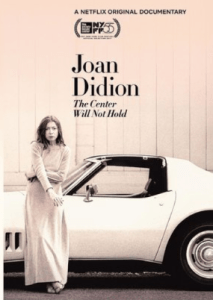
Didion, now 82, is the subject of a new documentary, Joan Didion: The Center Will Not Hold, directed by her nephew, Griffin Dunne. Her recollection of the little girl on acid scene serves as the exclamation mark of the film.  Here’s a description of the scene from writer Rebecca Mead in a recent New Yorker piece:

Dunne asks Didion what it was like, as a journalist, to be faced with a small child who was tripping. Didion, who is sitting on the couch in her living room, dressed in a gray cashmere sweater with a fine gold chain around her neck and fine gold hair framing her face, begins. “Well, it was . . .” She pauses, casts her eyes down, thinking, blinking, and a viewer mentally answers the question on her behalf: Well, it was appalling. I wanted to call an ambulance. I wanted to call the police. I wanted to help. I wanted to weep. I wanted to get the hell out of there and get home to my own two-year-old daughter, and protect her from the present and the future. After seven long seconds, Didion raises her chin and meets Dunne’s eye. “Let me tell you, it was gold,” she says. The ghost of a smile creeps across her face, and her eyes gleam. “You live for moments like that, if you’re doing a piece. Good or bad.”

And we wonder why a lot of people despise journalists.

It would follow, then, that the journalists milling around outside the emergency room at Parkland Hospital that sunny November Friday afternoon 54 years ago were nudging and winking at each other because, they too, were witness to news gold. Same thing when the 33 bodies were dug up from under John Wayne Gacy’s house. And how about those journalists who watched the World Trade Center towers collapse?

Great times, no?

Reminds me of the case of former Washington Post reporter Janet Cooke. She’d written a piece in September, 1980, entitled “Jimmy’s World,” the tale of an eight-year-old heroin addict. Cooke described in stunning detail Jimmy’s horrifying home. He’d been, she wrote, addicted to junk since he was five. Here’s a graf from the story:

Jimmy’s is a world of hard drugs, fast money and the good life he believes both can bring. Every day, junkies casually buy herion from Ron, his mother’s live-in-lover, in the dining room of Jimmy’s home. They “cook” it in the kitchen and “fire up” in the bedrooms. And every day, Ron or someone else fires up Jimmy, plunging a needle into his bony arm, sending the fourth grader into a hypnotic nod.

The nation was aghast. And Cooke and the Post reaped the highest award journalists can win in this holy land — the Pulitzer Prize.

Only it was all a lie. Cooke had fabricated the story. That one and, it turned out, several others. She was forced to return her award and has since left journalism. On the other hand, her talents certainly lie elsewhere, as the poet Gabriel Garcia Marquez observed: “[I]t was unfair that she won the Pulitzer Prize, but also unfair that she didn’t win the Nobel Prize in Literature.” Some 16 years later, Cooke sold the rights to the story of her “story” to Tri-Star Pictures for a cool $1.6 million.

Like Didion said, it was gold.

Royko

My journalistic idol, Mike Royko, reacted strongly to the Cooke fiasco. He speculated about how the Post editors read the story and, presumably, rubbed their hands together in greedy glee, thinking they had a real winner here. In the story, Cooke wrote that she called the kid “Jimmy” because she’d sworn to protect the identities of him and his caretakers, as well as all the other adults in the room in exchange for access. Post editors, Royko rightly noted, played along with the agreement because it was more important to them to have a blockbuster story than to, perhaps, rescue an eight-year-old from living hell. Royko wrote:

I’ll tell you what I would have done if I had been the editor and a young reporter came to me with that same story. I would have said something like this:

I want the name of the kid now. I want the name of the mother. I want the name of the guy giving the kid heroin. We’re going to have that sonofabitch put in jail, and we’re going to save that kid’s life. After we do that, then we’ll have a story.

But would it be gold?

Shayne In Spain

Should you find yourself around a copy of the current Ryder magazine (dated Oct. 9 to Nov. 20), pick the danged thing up and check out Shayne Laughter‘s piece on her fabulous jaunt into Spain this past summer.

The lucky dog, she’d hooked up with some kind of English-language immersion program for adult Spaniards so, for two weeks in July, she held court at some sweet digs — a luxe hotel in Madrid as well as some venerable castle out in the Iberian boondocks.

Apparently, the gig is open to all who fancy themselves fair teachers of our tongue, have the spare couple  of weeks, and can pop for the trans-Atlantic round-trip fare.

The whole shebang sounded like a hell of a lot of fun.

[MG Note: The piece hasn’t been posted yet on the Ryder website so you’ve got to go old school and find a hard copy.]

Business

Give once. Give every month. Or don’t give at all. Your choice. The Pencil’s going to be here no matter what.

Click Image To Donate

Hot Air: Lightning Hits

When Normalcy Returns

I’m just assuming that one day in the foreseeable future we’ll again have a president and an administration that don’t stun us with their childishness, their pettiness, their ignorance, and their thin skin every single goddamned day of the week.

Will we become bored then?

Then & Now

I noticed the other day that gasoline had hit $2.79 a gallon. Quite a jump from a few months ago when, IIRC, the price-per had dipped, albeit briefly, below two bucks.

It made me think of Nov. 2009, eight years ago exactly, when Barack Obama stood at the same point in his new presidency as the Bad Man who holds the same office today. Similarly, gas prices had leapt during O’s first year.

Social media went wild with people shrieking that the rise in the cost of motion lotion was due solely to the presence of BHO in the White House and, further, was concrete proof that he was a (pick one):

  • Communist
  • Kenyan
  • Muslim mole
  • Secret homosexual
  • Cocaine addict

This year? Those same people have been oddly quiet.

Prayboy

The governor of a state tweeting prayers in the aftermath of tragedy is code for, “Ain’t nothin’ I can do for ya.”

Reel-y?

Neighborhood/town/city/country reels after shooting/bombing/flood/tornado/hurricane is journalists’ code for “I left my Roget’s at home today.”


The Real Heroes

I’m sure those mourning their murdered loved ones are feeling quite a tad better this AM knowing that Sarah Silverman and Britney Spears have chimed in on yesterday’s mass shooting in Texas.

Hack Writer

As for Donna Brazile’s book, it’s best to keep in mind the raisons d’etre for any and all political books written by candidates, operatives, or power brokers are to portray the authors as extraordinarily perceptive and heroic and/or to absolve them of sin.

Phew!

So, the “antifa apocalypse,” AKA the civil war-cum-overthrow that was scheduled to begin Saturday, per Fox News, Alex Jones’ InfoWars, and every other lunatic-run “news” organization in this holy land didn’t come off.

My, my, my…, how to explain that? Oh, yes! It was the president himself who thwarted it!

Don’t ask how. It’s best not to ask too many questions at all. Just sleep tightly now, kids.

Fire & Rain

Lots of folks have been lamenting the lack of fall colors this year, with some of them attributing it to our rainless summer and early fall.

Let me assure you, the colors yesterday were out in…, well, Technicolor™, for pity’s sake. The Loved One and I motored through Brown County State Park, then out to Columbus, and finally through Seymour and back toward civilization via State Roads 50 and 446. The colors were vivid.

Enjoy them now when you have the chance.

As we sped westward in SR 50, brilliant, jarring flashes of lightning exploded in the distance. TLO, no fan of threatening weather, immediately whipped out her smartphone and put herself in touch with every meteorological service known to humankind. “Tornado warning,” she announced, somberly.

Sure enough, when we turned north on 446, the skies opened up, the winds howled, and atom bomb blast thunderclaps buffeted us. We had to pull over for long minutes. The wind not only rocked our hot rod from left to right but at certain moments, up and down.

I loved it. She didn’t.

Anyway, here are some color images and a shot of the deluge.

This slideshow requires JavaScript.


Hot Air: Workers’ Blues

Bang-Bang

Ricketts

The shuttering of DNAinfo outlets in New York, Chicago, San Francisco, Los Angeles, and Washington is a double-barrel shotgun blast to the faces of labor and journalism.

Newsroom workers at the New York office of the online news-gathering operation voted to join the Writers Guild of America East a week ago today. DNAinfo owner Joe Ricketts responded yesterday by closing the entire multi-city network down. Unions, he moans, are an impediment to business success.

I agree with him. Paying employees salaries and honoring standards like the 40-hour work week, giving workers vacations and providing a non-lethal workplace environment also hamper good, smart businessmen like Ricketts.

Who do these workers think they are?

A News Locavore

In recent years I’d turned more and more to DNAinfo Chicago for news of my beloved hometown, as opposed to the traditional dailies, the Tribune, Sun-Times, Daily Herald, or any of the ten other print publications available in the city. DNAinfo concentrated more on local news. That was okay by me; I could depend on the New York Times, the BBC, Al Jazeera, and dozens of weekly news and commentary magazines and even social media for my national and world news fixes.

“I believe people care deeply about the things that happen where they live and work,” Ricketts told an interviewer once about why he started the operation in 2009. Even though I don’t live there anymore, I still retain a keen interest in crime in, say, the Avondale neighborhood, or what sweetheart deals Mayor Rahm Emanuel is cooking up for his cronies in the LaSalle Street banks, the construction industry, and real estate. Ricketts’ operation kept me abreast.

But then, when his employees wanted to exercise their right to collectively bargain, well, to hell with anything he’d said before, he just shut the whole damned shebang down.

Kick ‘Em Where It Hurts

The PATCO Strike

Labor has been under assault in this holy land since even before St. Ronald Reagan committed his signature sin, firing the PATCO air traffic controllers in August, 1981. The Republicans, long antagonists of organized labor, cleverly determined that since unions were perhaps the largest contributors to Democratic coffers, they had to work day and night to dismantle them. The wrecking thereof began in earnest in the ’70s.

By the late ’80s and early ’90s union membership was down, precipitously, and labor’s sway over the Democrats had been reduced to a hint of a breeze.

In desperation, Dems led by Democratic Leadership Council rising superstars like the Clintons turned toward Wall Street for their mother’s milk, changing the party profoundly and alienating much, if not most, of its base.

The Rich Are Different From You And Me

Pure Greed

It got to the point that the strongest union in the nation was, improbably, the Major League Baseball Players Association, winners time and again against team owners in work stoppages from 1972 through 1994. But of course! Only in Reagan’s America would the nation’s remaining strong union represent a tiny, skilled group of employees whose minimum annual salary — attained through collective bargaining, naturally — be $535,000 and whose average annual pay is $4.47 million.

Unions, in other words, are fine for rich guys.

For those making, say, $9 an hour? Tough shit.

Who, again, do these workers think they are?

The Business Of America Is Business

And lots of people expect everybody to hold their hands over their hearts and thank the lord Jesus up above that they’re Americans while the Star Spangled Banner is played before a goddamned sporting event.

Action!

Now that that’s off my chest, let’s get back to Bloomington affairs. Like Big Talk.

My guests yesterday were John Armstrong and Zachary Spicer, the co-founders of Pigasus Pictures. The two met as undergrads at Indiana University, then years later reconnected in New York and formed their production company to shoot The Good Catholic, starring Danny Glover, John C. McGinley, Spicer, and Wrenn Schmidt. The 2017 release won the top jury award at the Santa Barbara Film Festival this past February.

Armstrong and Spicer relate the sad tale of what happened to the actual award they were given. Suffice it to say, the trophy sleeps with the fishes, to borrow a line from another award-winning film.

The boys have promised to shoot six more films here in Indiana over the next two or three years. Their non-profit, Pigasus Horizons, helps high school and college kids learn about the craft and business of filmmaking and even helps the most promising youngsters get work in the field.

Go here for the WFHB Daily Local News feature and here for the full-length orginal interview I did with Armstrong and Spicer.

Next week, IU Professor Theresa Ochoa, director of H.O.P.E., an innovative program connecting college student mentors with prison inmates in hopes of getting them jobs when their terms are up.

Hot Air: When Sorry = Not Sorry

Real, honest apologies are the glue that hold society together. They’re a trademark of adultness. The apologizer gives notice s/he is aware of something more in this life than her/his own needs and wants.

Me? I’ve had plenty of reasons to apologize to various people in my life over the years and have done so. A heartfelt apology accomplishes what the Catholic Church is aiming for in its Confession sacrament. It’s a cleansing, a new start, an act of love for another. Hell, the fact that the Catholics elevate it to sacrament-hood illustrates how important the act is both for the giver and the receiver.

That said, the 21st Cent. trend toward people in the public spotlight apologizing every 33 seconds for every burp, belch, and spittle-fleck is cheapening the act. A lot of the public confessionals are conditional: If I offended…. Just as many others are tantamount to copping a plea. A few more years of this and the apology will become meaningless.

Case in point: That baseball player who made racist gestures and comments the other day apologized almost before he was finished insulting the object of his puerility. The details: Yuli Gurriel of the Houston Astros hit a home run off Yu Darvish of the Los Angeles Dodgers in Game 3 of the World Series  Friday. When he returned to the dugout after circling the bases, he sat back on the bench and made slant-eyes with his fingertips and referred to his opponent on the mound as a chinito.

[Image: Vidcap From Fox Sports]

Darvish was born Farid Yu Darvishsefat in Habikino, Japan. His mother is Japanese and his father is Iranian. Yulieski Gurriel Castillo was born in Sancti Spiritus, Cuba and defected to the United States in 2016 so he could play Major League Baseball.

The term chinito (m.) or chinita (f.) is a Spanish slur for someone who comes from certain parts of Asia and could be classified, using archaic terminology, as part of the Mongoloid race. Those of us who read books recognize that race classifications are valueless and have zero scientific basis. Those to whom books are novelties, by and large, are thrilled to pieces to use racial descriptors as a way of establishing otherness. Those folks fixate, for example, on Asians’ epicanthic (or epicanthal) folds. Ergo, Gurriel’s slant-eyed gag.

Gurriel’s chinito slur is doubly insulting because Darvish is not Chinese. But that kind of silly detail means nothing to slurrers. To Gurriel, Darvish is somehow different, ergo, less than human. That’s a way of thinking that goes back a thousand generations. Early civilizations commonly referred to themselves as The People or The Men or even The Human Beings in whatever their language. Those who lived on the other side of the mountain or across the sea were not people, men, or human beings at all.

Today, we’re smarter. Well, some of us.

After Astros’ management apparently had their way with him, Gurriel issued an apology. Among the things he said were these:

In Cuba and in other places, we call all Asian people Chinese. But I played in Japan, and I know [that is] offensive, so I apologize for that.

I didn’t want to offend anybody. I don’t want to offend him or anybody in Japan. I have a lot of respect. I played in Japan.

His apology was less than real or honest. In fact, it implies that he did nothing at all to be ashamed of. Hey, in my country we insult the shit out of Asians all the time, so what’s the big deal? Using that logic, I could run around all day dropping N-bombs and excuse myself by saying in the neighborhood where I grew up, everybody dropped the N-bomb so quit being so damned sensitive about it!

He says, “I know [it’s] offensive.” Then he says, “I didn’t want to offend anybody.” So, the next time The Loved One and I get into a spat, I’ll haul off and slug her. Should she call the cops, I’ll just tell them Yeah, yeah, I know slugging her might hurt her — but I didn’t want to hurt her! So we’re cool, right? And if they still look askance, I’ll just say, Listen, I have a lot of love for her, and put my arm around her as she holds the ice bag to her nose.

Too many apologies are no apologies at all.

Carnegie’s Halls

I’m writing today at the Vigo County Public Library in Terre Haute. I’m becoming something of a local library connoisseur. In the last couple of weeks, I’ve bounced around from Bloomington’s Monroe County Public Library to the Brown County PL as well as Columbus’, Bedford’s, and Indianapolis’.

Libraries today serve two main purposes: as repositories of a community’s various information media and as social centers for the homeless. When I park myself at a table in some quiet corner of the library, I add a third purpose: the office away from home. I often look around and see one or two other such souls, their backpacks opened on their tables and their laptops in front of them. Ours is an exclusive club. There are unwritten, unpsoken rules, the primary one being, Don’t bother me; I’m busy.

Some homeless people cluster together and hash out all the slights and unfairnesses they’ve experienced since their meeting in the same spot yesterday. Often, these meetings are conducted at a higher than normally acceptable decibel level. I don’t resent them for this; I simply plop myself somewhere out of earshot. Others are less than gracious about these gripe sessions. I figure if the homeless can bear sleeping on a park bench or in a shelter at night I can bear moving my stuff a few yards away from their din in the daytime.

Anyway, some of the county facilities around these parts are Carnegie libraries, something I’d never heard of until I moved to Bloomington. (Vigo County’s is not one.) We have a Carnegie library in Bloomington at Washington and 6th streets. It used to be the home of the MCPL but is now headquarters for the Monroe County History Center. The current MCPL was built in 1970, after the Bloomington Public Library merged with the County’s library system. The old library had opened in 1918, one of a total of 2509 Carnegie libraries built around the world between 1883 and 1929. Carnegie’s dough paid for a library, for instance, in Fiji.

Some 1689 such structures were built in the United States. When the money Carnegie earmarked for library-building ran out, nearly half the libraries in this holy land were built on his dime.

This slideshow requires JavaScript.

Converting fin de siècle dollar values to today’s, it can be said Andrew Carnegie was one of the richest human beings ever to live. He was of a breed that’s sadly lost: the moral philanthropist. Today, most corporations or individual uber-rich people donate money for tax purposes or to enhance their brands. In  1889, Carnegie wrote an article called “Wealth” (later familiarly referred to as “The Gospel of Wealth“) for the North American Review wherein he called on his fellow tycoons and inheritors to spend their money to improve society, sort of a noblesse oblige on steroids. Carnegie reportedly gave away 90 percent of his fortune to efforts like library-building and other philanthropies.

Before we become too infatuated with Carnegie, it’s important to note his eponymous steel company battled tooth and nail against the Amalgamated Association of Iron and Steel Workers, culminating in the Homestead Massacre of 1892. Union organizers and workers were routed by goons hired by the Carnegie Steel Company, local cops, and the Pennsylvania national guard. At least ten people on both sides were killed in the week-long battle (some sources put the number at 16). Management in a wide variety of American industries were emboldened by Carnegie’s strike-breaking and union membership dropped precipitously thereafter.

Nevertheless, duality of man and all that, Carnegie’s dough — ill-gotten as some percentage of it was — has helped bring books to tens of millions of Americans.

Today there are a tad more than 9000 public libraries in the United States. So far I haven’t been able to determine the total number of public libraries around the world. Suffice it to say the number surely approaches 100,000. Add to that number all the school, university, industry, association, church and religious and all other libraries and the figure for all places where books and films and audio recordings and so forth are kept must approach a million.

That thought, alone, makes me happy to be alive.

And here’s a treat. Eyeball some of these interior and exterior shots of spectacular libraries around the world:

This slideshow requires JavaScript.