Category Archives: Coca-Cola

757 Words: Inventive America

AMERICA 250

My series on the highlights and lowlights of American history, marking this nation’s 250th birthday. The whole idea being we, as a nation, have done great things and we’ve done rotten things. And sometimes the things we’ve done have been both great and rotten. We are, to be sure, all too human.

In the latter years of the 19th century, a huge number of machines, devices, tools, implements, and other objects that made human life a tad easier, incrementally, were invented. Americans either by birth or immigration like Tesla, Edison, Bell, Deere, and Westinghouse are recognizable to this day. And then there were anonymous innovators like Wisconsin farmer Peter Houston who invented the roll-film camera and housewife  Josephine Cochrane, an imaginative and brilliant tinkerer who invented the first automatic dishwasher.

Josephine Cochrane

Cochrane was married to a fellow who made bushels of money as a dry goods merchant. They lived in a big Chicago mansion. One day, she threw a dinner party and, after it was over, her kitchen staff washed the dishes. In the process, they chipped a bunch of her heirloom china pieces. She thought there had to be a better way so she sat down with pen and paper and got to drawing machines that would use boiling water to clean dinnerware.

Her eventual automatic dishwasher became so successful that she formed a corporation to produce it and other gadgets she came up with. Her company eventually became known as KitchenAid.

A later Cochrane dishwasher design

Such was life in post-Civil War America. Entrepreneurs, scientists, and just plain folks — brilliant all — could invent things that would change the world…, or at least some small part of it.

Perhaps the two longest-lasting identifiable American brand names were made possible by inventions in 1873 and 1886. The first was a minuscule hunk of copper. The second, a patent medicine and alcohol alternative sold in a Georgia drugstore.

Levi Strauss was a San Francisco dry goods merchant specializing in work clothes for miners and factory workers. He wanted to design pants that would be both comfortable and durable, previously incompatible clothing characteristics. Strauss and his denim fabric vendor in 1872 realized simple stitching would not hold good work trousers together well so he invented “An Improvement in Fastening Pocket-Openings,” copper rivets, that would make his soon-to-be named Levi Strauss blue jeans arguably the second most important and successful attire innovation in human history. Only the loom, I’d argue, made articles of clothing more accessible, affordable, and universal. Strauss gained US Patent No. 139,121 on May 20, 1873 for his rivet.

Blue jeans are worn in every continent and in every country. They are as American as Coca-Cola.

A Georgia pharmacist named John Pemberton, who became a Confederate lieutenant colonel during the Civil War, suffered a saber wound in his chest during a battle in Georgia. He became addicted to morphine to cope with the pain. Having studied medicial chemistry in the 1840s, Pemberton experimented with different concoctions, hoping to wean himself off dope. He wasn’t the only southerner suffering in the post-bellum years. Drug addiction, alcoholism, and pathological depression were rampant among the defeated population. Pemberton tried substances like the poisonous buttonwood plant, hoping to extract a painkiller and overall sedative that would help him and others.

Pemberton distilled a compound made of coca leaves and kola nuts that was actually a type of wine at first. Then, with the temperance movement beginning to rage across the nation, he had to find a way to make his concoction alcohol-free. He and another pharamcist friend experimented with different recipes for his coca and kola mixture. One day, Pemberton accidentally spilled carbonated water into his latest mix. Voila.

Coca-Cola bottles through the years

I can’t provide any more detailed information on how Pemberton and his friend came up with Coca-Cola as it is, literally, a more closely-guarded secret than the instructions for making a primitive atom bomb. We do know, though, that Pemberton chose to market his compound under its now-ubiquitous brand name for no better reason than it sounded just right. It was alliterative and punchy and memorable.

Coca-Cola is drunk on every continent and in every country. It is as American as blue jeans.

●

The arc of the moral universe is long, but it bends toward justice. — Theodore Parker.

Power concedes nothing without a demand. It never did and it never will. — Frederick Douglass.

It is possible to read the history of this country as one long struggle to extend the liberties established in our Constitution to everyone in America. — Molly Ivins.

Awesome Hot Air

God is all around me.

And it’s bugging me. You know as well as I do how pervasive the old bird is.

Well, not exactly him, but his messengers and agents. He has priests, pastors, imams, rabbis, lamas, and a whole raft of other paid flacks. On top of that he depends on millions and millions — wait, billions — of unpaid volunteers who are more than happy to crow about what a swell dude he is. Perhaps only The Coca-Cola Company of Atlanta, Georgia has a publicity machine as widespread.

God's Guys

Brand Strategists

■

Walk into any diner and order a cola. When the waitperson repeats your order, s/he’ll say, “And you wanted a Coke, right?”

Right. Even if it’s a Faygo or a Pepsi, it’s a Coke.

Same with the Big Daddy-o in the Sky. Whenever a legislative body wants to initiate proceedings for the day, it calls in Christ’s vicar or G_d’s interpreter to start the festivities off right. Whenever a plane crashes or a lunatic opens fire in a shopping mall, people climb all over each other to say the Big Boy himself was responsible for any survivors. Hell, I sneezed the other day and some woman said, “God bless you.”

He’s everywhere.

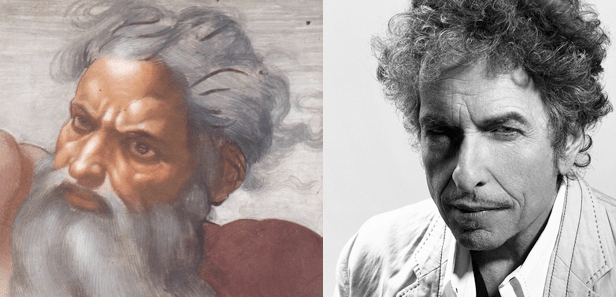
Only he’s not. Like Bob Dylan, he’s not there.

And, like Dylan, his reputation is based on layers upon layers of bombast and myth.

There is no Bob Dylan, as you well know. There is a fellow named Robert Allen Zimmerman, born May 24, 1941, who one day decided to market himself by borrowing the given name of the poet Dylan Thomas and adopting it as his surname.

Both Bob Dylan and god have had spectacularly trenchant and brilliant mots attributed to them. These pearls of verbiage, though, have been largely excavated from under massive piles of nonsensical and silly pronouncements.

Maybe Bob Dylan is god.

Blake's God/Dylan

Separated At Birth?

■

Nah. Can’t be. Because there is no god.

The godly among the populace will counter that it is the height of presumption for me to say such a thing. Pious logicians will argue that I cannot definitively assert the non-existence of something. To which I might respond, Okay, you guys have had some 50,000 years (yup, humans in the Upper Paleolithic Period worshiped a god) to prove the Large Lummox created everything and is concerned with love, peace, war, and the result of yesterday‘s Monday Night Football game. You haven’t yet.

Carl Sagan famously told about the fire-breathing dragon in his garage. Prove that it isn’t there, he said. Guess what: You can’t.

Then the believers will cluck their tongues and shake their heads. How sad, they’ll lament, that you’re so lacking in awe and wonder. Your world is empty and prosaic. They’ll tell me that when they look at the petals of a flower they see the handiwork of the creator. When I look at it, I see a bionic machine. Such an emotionally empty experience.

Not so. For instance, I could hardly get to sleep last night after reading about astronomers’ latest supposition that tens of billions of stars in our own Milky Way Galaxy host Earth-like planets in their Goldilocks Zones (that is, the area around them that is just right for terrestrial type life to develop in.)

Habitable Zone

■

Dig: One of the astronomers who studied the results of a four-year Kepler Space Telescope search for Earth-like exo-planets was driven to ejaculations of Oh, Wows by what he’d learned. Here’s Erik Petigura of the University of California-Berkeley:

When you look up at the thousands of stars in the night sky, the nearest sun-like star with an Earth-size planet in its habitable zone is probably only 12 light years away and can be seen with the naked eye. That is amazing.

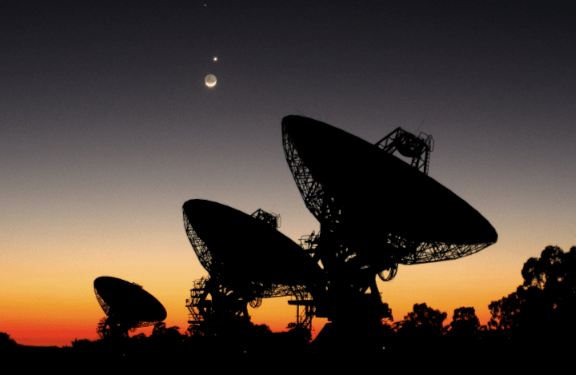
So tonight, I’m going out in the backyard to look at the dark sky. Weather permitting, I’ll see dozens and dozens of stars up above. If I feel really ambitious, I might take the five minute drive down to Lake Monroe, where the sky is even darker, so I can see many more stars. And as I watch them twinkle, the odds are overwhelming that I’m seeing, as it were, the homes of countless civilizations that communicate, reproduce, fight, discover, share, and play football. Maybe even baseball, if their intelligence is advanced enough.

And I will be in awe. My imagination will run wild. I’ll try to think about what those creatures look like. I’ll ponder the near-impossibility of humans ever visiting them. I’ll hope for the much more likely chance that we’ll exchange messages, perhaps soon.

Radio Telescope Array

“Are You There?”

■

The feeling I’ll have will easily be as profound as that of someone who marvels that god let that plane go down, with several hundred poor souls burned to a crisp and torn limb from limb, but decided, because he is loving, to spare one little tot.

This I guarantee: My awe will be far more holy than that of the football fan or the tight end who was certain god deigned that the Bears beat the Packers last night.

▼

Spirit In The Sky

▲