America 250
My series on the highlights and lowlights of American history, marking this nation’s 250th birthday. The whole idea being we, as a nation, have done great things and we’ve done rotten things. And sometimes the things we’ve done have been both great and rotten. We are, to be sure, all too human.
In 1776, the rebellious colonists issued their Declaration of Independence. It was an announcement to the world that a new country had formed, along the shores, mostly, of the Atlantic Ocean on the North America continent.
It begins with the words, “We the people….” No document had ever been created like if before in the history of humanity. A casual reading of the Declaration might indicate its authors were speaking for an entire nation of just plain folks — no royalty, no nobility, everybody.
The Constitution, written eleven years later, was, in part, based on a nearly five hundred year old alliance made by indigenous nations who lived west of the Appalachian Mountains and whose lands extended out to lakes Ontario and Erie, up into what is now Michigan, and as far west as the Mississippi River. It was called the Haudenosaunee Confederacy.
Those indigenous nations, who’d been beating the hell out of each other for centuries, decided to make peace and set up a loose alliance of semi-sovereign state-like plots of land, the bunch of which would consider themselves a single entity. The quasi-states would trade with each other and protect each other when the need arose. They called their founding pact The Great Law of Peace.
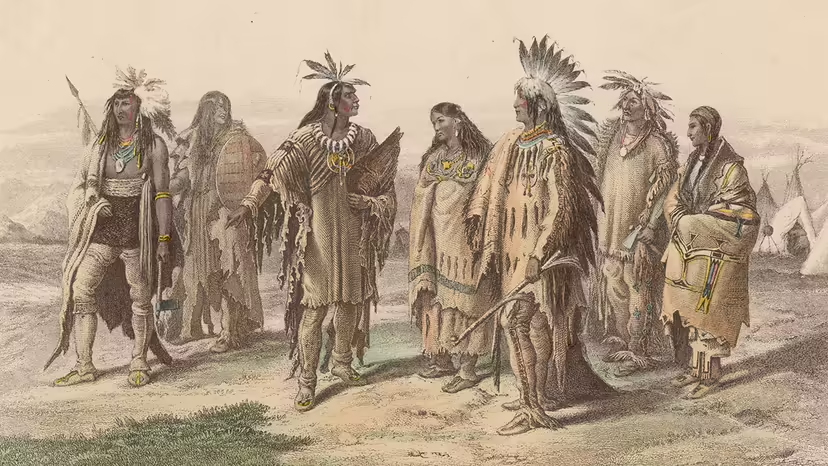
Representatives of the Iroquois, Assiniboine, Crow, Pawnee, and Dakota peoples (artist’s conception).
The founding five nations, with a sixth eventually joining, became matrilineal societies, with birthrights, inheritances, and living arrangements based on mothers’ bloodlines. That’s definitely not what either Britain or the newborn independent colonies had in mind, but much of the rest of the Iroquois Confederacy’s governance principles inspired the authors of the Constitution.
Contradiction No. 4: All Men Are Created Equal. They weren’t of course, according to the new country’s charter. Women and Blacks and people who didn’t own land were intentionally excluded from the “We” mentioned in the Declaration of Independence when the Founders got around to writing the Constitution eleven years later.
But, as contract law and commons sense tell us, if you say you’re going to do something, you are legally bound to do it. Even though the authors of the Constitution stood on their heads to exclude certain groups from its guarantees of rights, that single, simple pledge, All Men Are Created Equal, was a holy grail (lower case) that would spur all the Abolitionists, the civil rights workers, the Suffragettes, and every other gang working to achieve equality and guaranteed rights. It helps explain, for instance, why Black US Army soldiers could fight with such valor and determination in World War II, even though the country they were fighting for segregated them, imposed Jim Crow laws on them, and did all it could to convince them they were not as good, not as worthy, as White people.
All Men Are Created Equal was a promise. A lot of blood has been shed by people trying to get America to keep that promise.