AMERICA 250
My series on the highlights and lowlights of American history, marking this nation’s 250th birthday. The whole idea being we, as a nation, have done great things and we’ve done rotten things. And sometimes the things we’ve done have been both great and rotten. We are, to be sure, all too human.
In an ideal world, this highlight in the history of the United States would never have been necessary.
But it had to be. The United States was a slave nation.
The year was 1845. The month, May. The book, Narrative of the Life of Frederick Douglass, an American Slave, was published by the Boston Anti-Slavery Society.
It is one of the two or three most important American books ever published. If you say it’s the most important American book, I won’t argue with you.
It was the first of Douglass’s three memoirs. Ironically, for such a person who would delve into and write so forcefully and thoroughly about his life, Douglass had no idea when and where he was born. That was typical for slaves. Any hints of human history, self-inspection, aspiration, curiosity, and even the desire to read had to be beaten out of them.
Douglass taught himself to read as a child after hearing one or another master say slaves shouldn’t be literate, otherwise they’d start thinking they should be free. That, the young Douglass concluded, meant reading was of utmost importance. Douglass would come to understand he, a human being, was, in his keepers’ eyes nothing more than a piece of property.
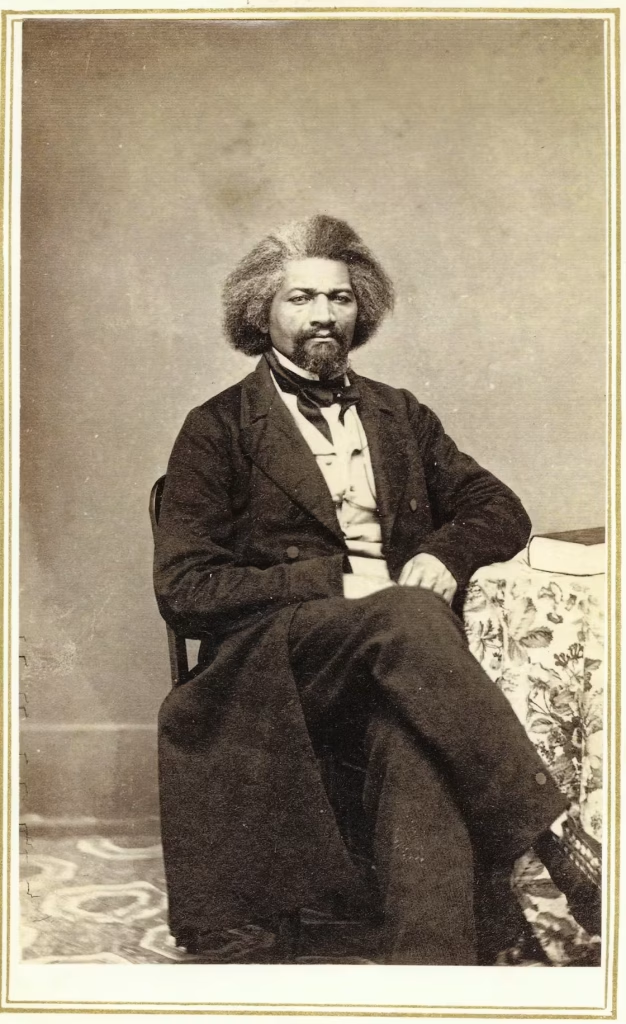
Frederick Douglass
Slavery, Douglass tells us, is immoral. Now, of course, that sounds elementary. It wasn’t so much in 1845. Oh sure, there were abolitionists here and there but the vast majority of northern White Americans were too busy taking care of their own families and farms and shops to think much about what was going on in southern plantations. Just as obviously, southerners didn’t consider slavery immoral because, hell, their whole economy, their culture, their very identity depended on involuntary servitude.
Think of how earth-shattering it would have been in 1845 to read the memoir of an intelligent, observant, curious, rational, and emotional human being — .whose skin was black and whose rights didn’t exist.
In an ideal world, Frederick Douglass’s memoirs would have recounted his experiences as a college professor, a noted philosopher, an innovative physician, a senator, or even a president. He was born far too soon to have a chance to become any of those things in the United States of America.
His name, on the other hand, will live forever in our history, more so, perhaps, than if he had been a president of Harvard or the doctor who discovered the importance of hand-washing.
His book was as invaluable as anything in the coming overthrow of slave culture in America.
He was one of this country’s most important human beings.
There are scads of ways to read Douglass’s Narrative. Here are a few, online:
- From the University of North Carolina at Chapel Hill
- From Project Gutenberg
- From Internet Archive
- An audio/video reading of it from American Writers Museum
Or you can buy the book.
●