Category Archives: Frederick Douglass

581 Words: A Most Important Life

AMERICA 250

My series on the highlights and lowlights of American history, marking this nation’s 250th birthday. The whole idea being we, as a nation, have done great things and we’ve done rotten things. And sometimes the things we’ve done have been both great and rotten. We are, to be sure, all too human.

In an ideal world, this highlight in the history of the United States would never have been necessary.

But it had to be. The United States was a slave nation.

The year was 1845. The month, May. The book, Narrative of the Life of Frederick Douglass, an American Slave, was published by the Boston Anti-Slavery Society.

It is one of the two or three most important American books ever published. If you say it’s the most important American book, I won’t argue with you.

It was the first of Douglass’s three memoirs. Ironically, for such a person who would delve into and write so forcefully and thoroughly about his life, Douglass had no idea when and where he was born. That was typical for slaves. Any hints of human history, self-inspection, aspiration, curiosity, and even the desire to read had to be beaten out of them.

Douglass taught himself to read as a child after hearing one or another master say slaves shouldn’t be literate, otherwise they’d start thinking they should be free. That, the young Douglass concluded, meant reading was of utmost importance. Douglass would come to understand he, a human being, was, in his keepers’ eyes nothing more than a piece of property.
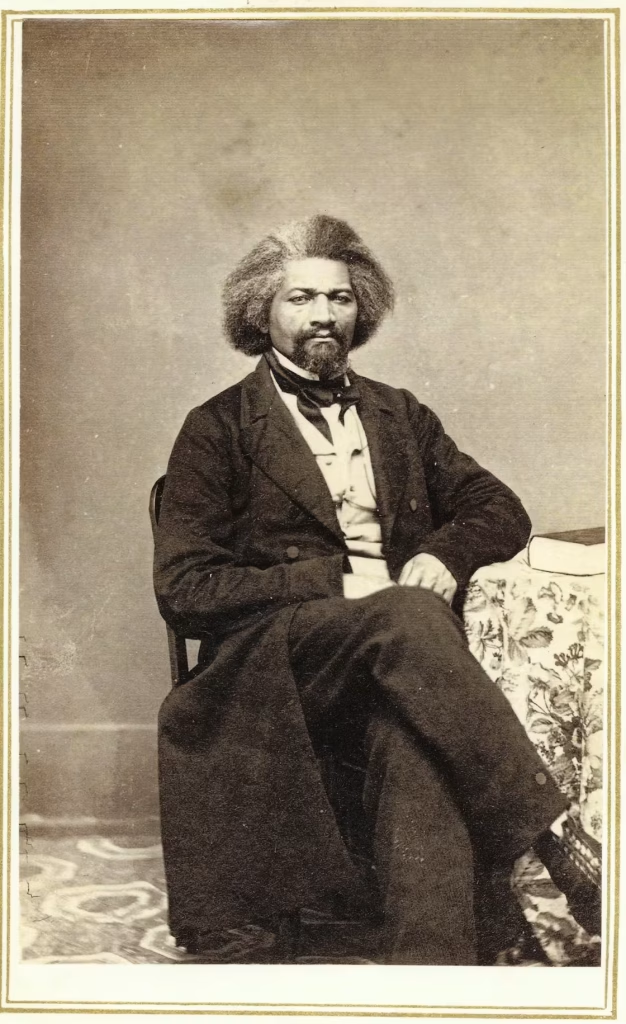
Frederick Douglass

Slavery, Douglass tells us, is immoral. Now, of course, that sounds elementary. It wasn’t so much in 1845. Oh sure, there were abolitionists here and there but the vast majority of northern White Americans were too busy taking care of their own families and farms and shops to think much about what was going on in southern plantations. Just as obviously, southerners didn’t consider slavery immoral because, hell, their whole economy, their culture, their very identity depended on involuntary servitude.

Think of how earth-shattering it would have been in 1845 to read the memoir of an intelligent, observant, curious, rational, and emotional human being — .whose skin was black and whose rights didn’t exist.

In an ideal world, Frederick Douglass’s memoirs would have recounted his experiences as a college professor, a noted philosopher, an innovative physician, a senator, or even a president. He was born far too soon to have a chance to become any of those things in the United States of America.

His name, on the other hand, will live forever in our history, more so, perhaps, than if he had been a president of Harvard or the doctor who discovered the importance of hand-washing.

His book was as invaluable as anything in the coming overthrow of slave culture in America.

He was one of this country’s most important human beings.

There are scads of ways to read Douglass’s Narrative. Here are a few, online:

  • From the University of North Carolina at Chapel Hill
  • From Project Gutenberg
  • From Internet Archive
  • An audio/video reading of it from American Writers Museum

Or you can buy the book.

The arc of the moral universe is long, but it bends toward justice.Theodore Parker.

Power concedes nothing without a demand. It never did and it never will. — Frederick Douglass.

It is possible to read the history of this country as one long struggle to extend the liberties established in our Constitution to everyone in America. — Molly Ivins.

The Pencil Today:

THE QUOTE

“Power concedes nothing without a demand. It never did and it never will.” — Frederick Douglass

DIBS ON DEBS

Wow.

That’s all I have to say.

Wow.

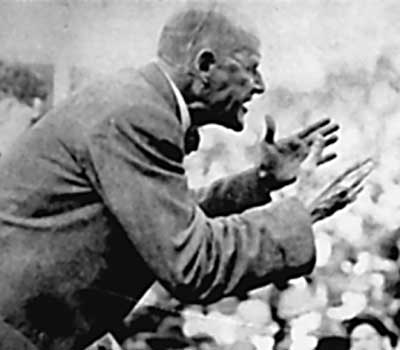
The Indy Star today ran a front pager on radical labor leader and committed socialist Eugene V. Debs in honor of Labor Day, natch.

Debs In Canton, Ohio

Now, the Star is not to be confused with the old Daily Worker newspaper or even Mother Jones magazine. In fact, the Star pretty much reflects the rocked-ribbed Republican base in Indiana. For pete’s sake, the paper was started by an industrialist, George F. McCulloch, back in 1903.

Industrialists don’t generally start up papers — or television stations or websites, for that matter — in order that the sweating classes might be whipped into rebellion.

That’s what Eugene V. Debs did all his adult life. He was deemed such a threat to the good order of the nation that he was thrown in prison twice for being, essentially, too charismatic.

And by the way, that good order of the nation? It’s still the same today — those that have, fight like tigers to keep it; those that don’t and make noises about it are called traitors, terrorists or, even worse, liberals.

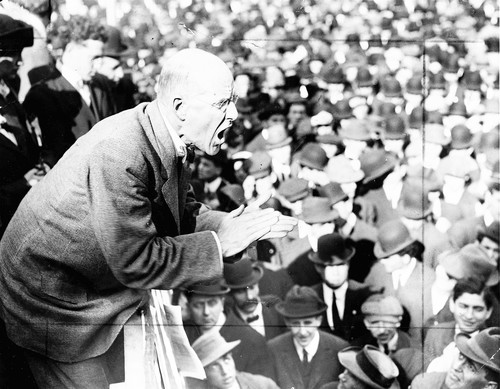
Debs was born in Terre Haute, which partially explains why the Star might deign to write about him on Labor Day. He was so popular that when he was sprung from the Atlanta Federal Penitentiary by President Warren G. Harding in 1921, a crowd of 50,000 greeted him when he returned home to Terre Haute.

Anyone who wonders why he was imprisoned twice in his life need look no further than than for a reason. Guys who can draw crowds of 50,000 are either top-flight quarterbacks or dangers to the nation.

Debs Before A Crowd

Anyway, Debs is one of the most important Americans in history. He’s generally seen by the Far Right as something akin to a child molester. The thankfully-almost-forgotten Glenn Beck once described Debs as a racist/communist.

So, cool, the Indy Star gives the home-state boy his due. Maybe — just maybe — things aren’t all as lost as they sometimes seem.

Here are some good reads on Debs and the American labor movement:

TEACHERS UNION RALLY

For my Chicago friends, get on over to the Daley Center Plaza today at 10:30 for a rally in support of the Chicago Teachers Union.

Meet Here

Chicago Public School teachers may go on strike a week from today because contract negotiations have bogged down. School starts tomorrow.

Here’s an irony: the billionaires who own the Chicago Cubs want the city and the state to pick up several hundred million dollars of the cost for a proposed massive refurbishment of Wrigley Field. If the city screws its school teachers out of nickels and dimes but then throws a pile of cash at the Ricketts family and the cash cow that is the Cubs, I wouldn’t blame a soul for taking to the streets.

THANKS

The AFL-CIO presents 36 Reasons Why You Should Thank A Union. Here are a few:

  • Weekends without work
  • All breaks, including lunch
  • Paid vacation
  • Sick leave
  • Minimum wage

  • Overtime pay
  • 8-hour day
  • 40-hour week
  • Pensions
  • Workplace safety standards
  • Holiday pay
  • Equal pay for men and women doing the same jobs

Just in case you were wondering what we were celebrating today.

LIVING FROM CHECK TO CHECK

Finally, speaking of nickels and dimes, make it your business this week to buy Barbara Ehrenreich’s fabulous book on the working poor, “Nickel and Dimed: On (Not) Getting by in America.”

It’s worth ten academic treatises on labor for illustrating the lives of people for whom a five dollar bill is an important thing.

Here’s how I waste my time. How about you? Share your fave sites with us via the comments section. Just type in the name of the site, not the url; we’ll find them. If we like them, we’ll include them — if not, we’ll ignore them.

I Love ChartsLife as seen through charts.

XKCD — “A webcomic of romance, sarcasm, math, and language.”

SkepchickWomen scientists look at the world and the universe.

IndexedAll the answers in graph form, on index cards.

I Fucking Love ScienceA Facebook community of science geeks.

Present/&/CorrectFun, compelling, gorgeous and/or scary graphic designs and visual creations throughout the years and from all over the world.

Flip Flop Fly BallBaseball as seen through infographics, haikus, song lyrics, and other odd communications devices.

Mental FlossFacts.

SodaplayCreate your own models or play with other people’s models.

Eat Sleep DrawAn endless stream of artwork submitted by an endless stream of people.

Big ThinkTapping the brains of notable intellectuals for their opinions, predictions, and diagnoses.

The Daily PuppySo shoot me.

Electron Pencil event listings: Music, art, movies, lectures, parties, receptions, games, benefits, plays, meetings, fairs, conspiracies, rituals, etc.

Monday, September 3, 2012

The BishopMusic: Jens Lekman Listening Party; 9pm

ONGOING

◗ Ivy Tech Waldron CenterExhibits:

  • “40 Years of Artists from Pygmalion’s”; through September 1st

◗ IU Art MuseumExhibits:

  • “A Tribute to William Zimmerman,” wildlife artist; through September 9th

  • Willi Baumeister, “Baumeister in Print”; through September 9th

  • Annibale and Agostino Carracci, “The Bolognese School”; through September 16th

  • “Contemporary Explorations: Paintings by Contemporary Native American Artists”; through October 14th

  • David Hockney, “New Acquisitions”; through October 21st

  • Utagawa Kuniyoshi, “Paragons of Filial Piety”; through fall semester 2012

  • Julia Margaret Cameron, Edward Weston, & Harry Callahan, “Intimate Models: Photographs of Husbands, Wives, and Lovers”; through December 30th

  • “French Printmaking in the Seventeenth Century”; through December 30th

  • “Workers of the World, Unite!”; through December 30th

◗ IU SoFA Grunwald GalleryExhibits:

  • “Media Life,” drawings and animation by Miek von Dongen; through September 15th

  • “Axe of Vengeance: Ghanaian Film Posters and Film Viewing Culture”; through September 15th

◗ IU Kinsey Institute Gallery“Ephemeral Ink: Selections of Tattoo Art from the Kinsey Institute Collection”; through September 21st

◗ IU Lilly LibraryExhibit, “Translating the Canon: Building Special Collections in the 21st Century”; through September 1st

◗ IU Mathers Museum of World Cultures — Reopens Tuesday, August 21st

Monroe County History CenterPhoto exhibit, “Bloomington: Then and Now” by Bloomington Fading; through October 27th